Jack McCall: The Man Who Killed Wild Bill Hickok
On November 9, 1876, two men attempted to escape from the jail in Yankton, Dakota Territory. Both had been accused of murder and were awaiting their respective trials.
The first man was Jeremiah McCarty, charged with murdering John Hinch in a saloon dispute in the Black Hills. The second was Jack McCall, the man who shot and killed famous scout, pistoleer, and lawman Wild Bill Hickok in Deadwood on August 2 of that year.
When J.B. Robinson made his rounds to lock up each inmate that night, McCarty grabbed him by the throat, overpowering the unsuspecting jailor.
McCall quickly joined in, wrote the Daily Press and Dakotaian:
McCall then came to the assistance of McCarty, pounded Robinson on the head and body until he was nearly unconscious and then took his keys away from him. The two desperadoes then broke their shackles with the round of a chair and proceeded to liberate themselves from confinement.
As Robinson lay on the ground, McCarty and McCall opened the jail door and stepped outside—right into U.S. Marshal James H. Burdick and his assistant, James Bennett.
Burdick “placed the business end of his revolver in unpleasant proximity to the heads of the escaping murderers,” reported the Daily Press and Dakotaian, and the would-be escapees slunk back into their cells and irons.
For Jack McCall, the attempted breakout was one of several ways he tried to skirt his legal fate from the time he killed Wild Bill in the No. 10 saloon until he was finally hanged on March 1, 1877.
McCall’s motives for the murder were never quite clear, but one thing was certain: if there was a way for him to escape the gallows, he would try it.
The Murder of Wild Bill Hickok
James Butler Hickok, better known as Wild Bill, had only been in Deadwood for three weeks when he was shot in the back of the head in Nuttal and Mann’s No. 10 saloon on August 2, 1876.
Just five months earlier, Hickok had married Agnes Lake in Cheyenne, Wyoming Territory. As a newlywed, he was motivated to find stability and financial security for himself and his bride.
The recent gold rush to the Black Hills—what were still sacred, supposedly protected lands of the Sioux under the 1868 Treaty of Fort Laramie—appeared to be Hickok’s best chance to cash in as he faced mounting health issues and a waning prime on the frontier.
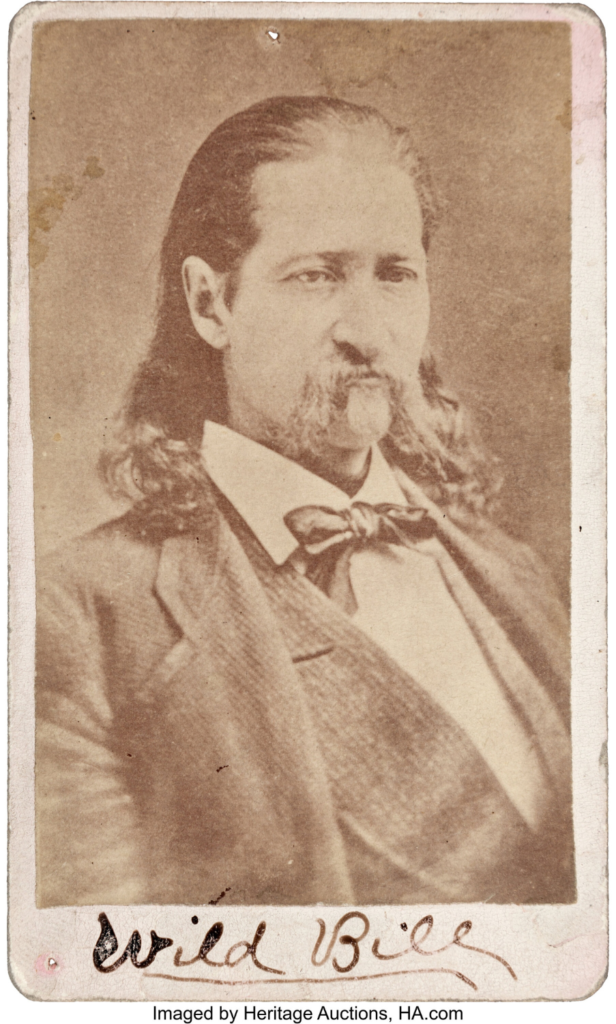
“If he could once make a strike,” wrote Joseph Rosa in They Called Him Wild Bill: The Life and Adventures of James Butler Hickok, “he could return to his wife perhaps to retire or engage in less dangerous pursuits.”
In late June, Hickok—along with Colorado Charlie Utter and Utter’s brother Steve—left with a caravan of about 100 travelers headed from Cheyenne to Deadwood.
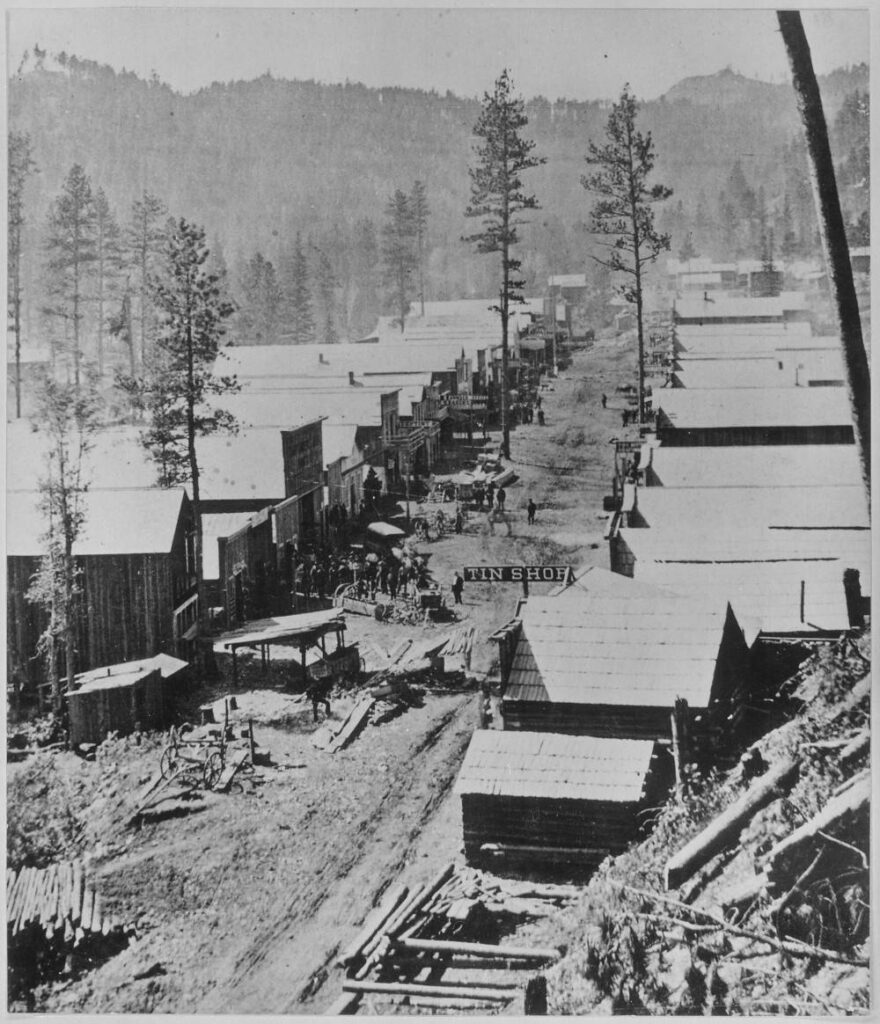
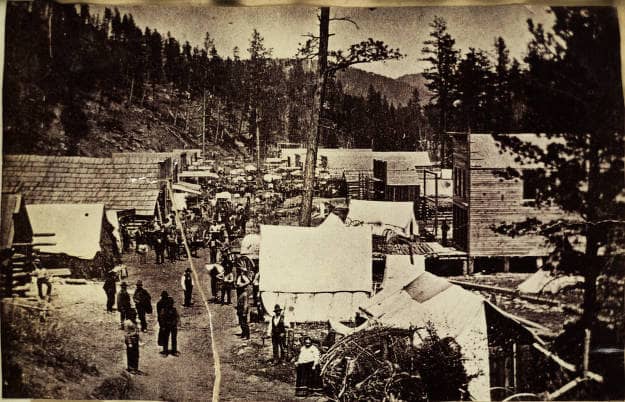
The trip lasted two weeks, and the group arrived in Deadwood around July 12, where they experienced firsthand the turbulent and fast-growing boomtown. That summer, many of Deadwood’s earlier canvas tents and ramshackle buildings were being replaced by more refined storefronts, but the town was still the rough-and-tumble nerve center of the Black Hills.
“Deadwood was the industrial supply center, shopping center, financial hub, and hellhole of raucous entertainment for the whole area,” wrote Watson Parker in Deadwood: The Golden Years, “and it gloried in its reputation as ‘boss city of the Hills.'”
Part of that “raucous entertainment” included saloons, of which there were many, wrote Rosa:
For every store there were three saloons, and above the click of dice and poker chips rang the voices of the dealers and the players. Sometimes a gun thundered. The citizens of Deadwood were, like their town, completely lawless.
During Wild Bill’s short stay in Deadwood, he spent time prospecting in the hills, but he could also be found in a few of his favorite haunts, including the No. 10 saloon, run by Carl Mann and Jerry Lewis.
On the night of August 1, 1876, Hickok played poker at the No. 10 with several players, including Captain William R. Massie, a steamboat pilot who’d worked the Mississippi and Missouri Rivers.
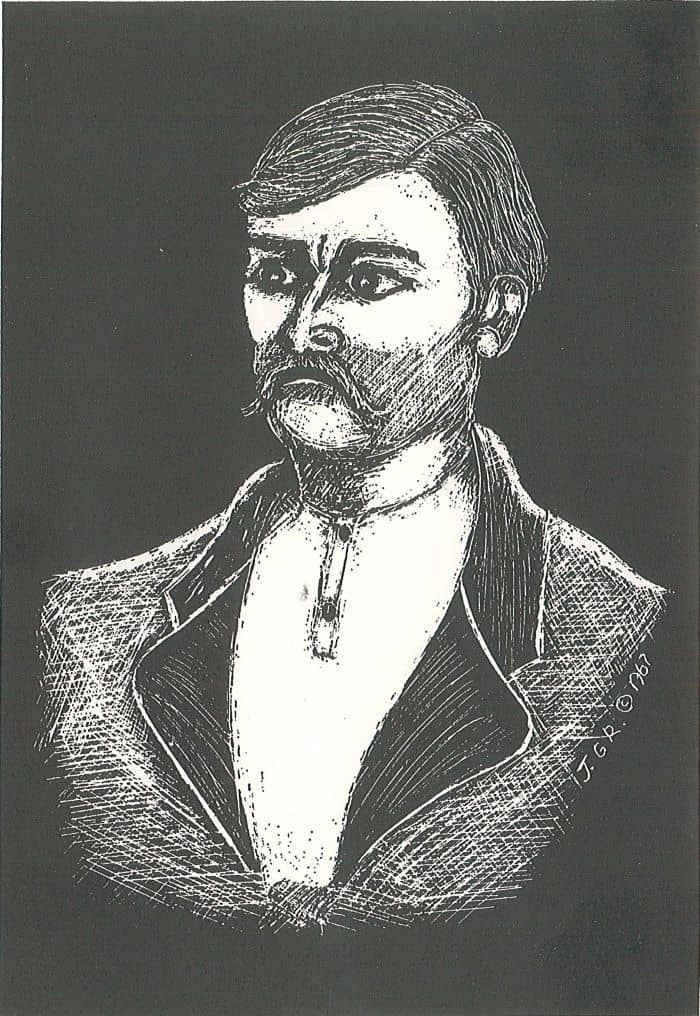
When one unknown player left the game, his spot was taken by Jack McCall, a laborer and miner in the area whom Carl Mann had seen only a few times before. Little was known about McCall, who had apparently come west from Kentucky and hunted buffalo in the early 1870s. He was about 24 or 25 and described as having a crooked nose, at least one crossed eye, and a flushed complexion.
That night, Hickok beat McCall and, perhaps in a blow to the latter’s ego, lent him money to eat, testified Mann after the murder:
After playing a short time he [McCall] took a purse from his pocket and bet five or six dollars and Bill bet twenty or twenty-five more. McCall shoved his purse further onto the board and says ‘I call you.’ Bill won and they came to the bar and asked me to weigh out $20 or $25. The purse was $16.50 short. Bill said ‘you owe me $16.25.’ McCall said ‘yes’ and went out. He came back shortly after and Bill said ‘did I break you?’ McCall said ‘yes.’ Bill gave him all the change he had, 75 cents, to buy his supper with and told him that if he quit winner in the game he was playing he would give him more. McCall would not take the money and went out in fifteen or twenty minutes.
Mann’s legal testimony
Curiously, before going to Mann’s saloon that night, Hickok wrote to his wife, Agnes, that “if such should be we never meet again, while firing my last shot, I will gently breathe the name of my wife—Agnes—and with wishes even for my enemies I will make the plunge and try to swim to the other shore.”
According to Rosa, Hickok’s time in Deadwood was marked by his own premonitions, and on more than one occasion, he told friends that he believed the Black Hills town would be his “last camp.”
Sometime after noon on August 2, Hickok again wandered into the No. 10 saloon and joined an ongoing game between Captain Massie, Carl Mann, and Charlie Rich.
Hickok asked Rich twice to switch spots so that Hickok’s back could face the wall—to see both the front and rear entrances to the saloon—but Rich refused, as the other players “good-naturedly ribbed” the frontier legend.
Why Hickok continued playing with his back to the rear entrance remains a mystery, given his usual diligence in positioning himself to prevent anyone from catching him off guard.
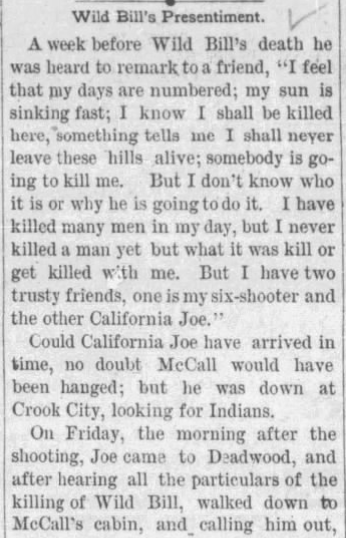
“This has been his ruel [sic] for many years, since his career of law enforcement had developed a long list of men who swore they would shoot him at the first opportunity,” reported The Black Hills Pioneer a week after Hickok’s death.
Around 3 p.m., Jack McCall walked in the front entrance of the saloon and headed to the end of the bar at the back of the building. From there, he was a few steps behind Hickok’s stool. Before the frontiersman knew what happened, the loud bang of a revolver echoed through the saloon.
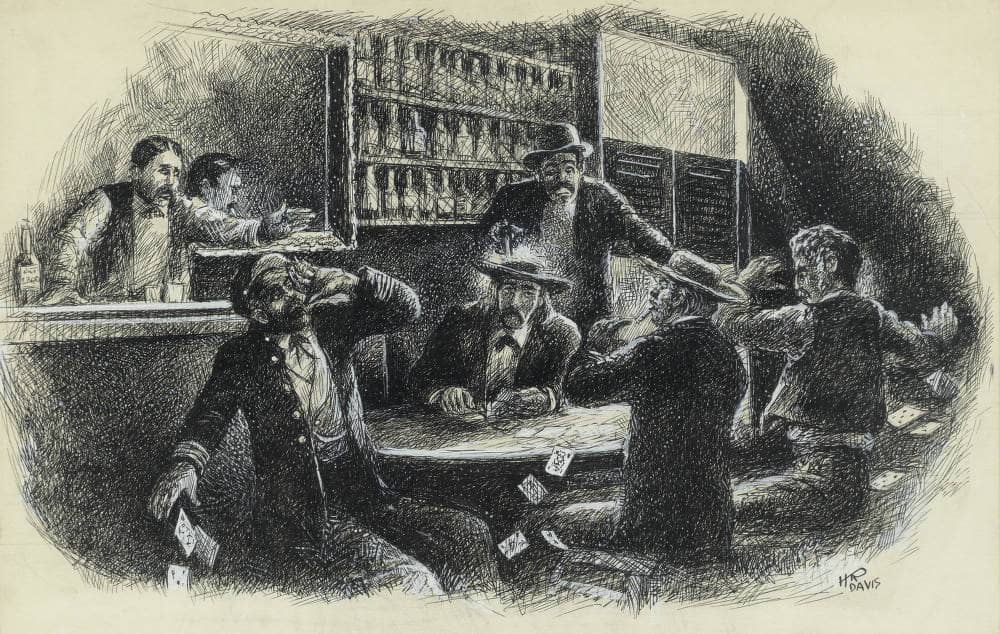
Witnesses claimed that before the shot, McCall yelled, “take that,” or “damn you, take that,” or some variation. In his own testimony, McCall later claimed to say “look out” before firing his revolver.
Hickok died immediately. He sat motionless for a moment before falling backward onto the floor.
The ball that killed Hickok then lodged into the left hand of Captain Massie, who “felt a shock and numbness” in his wrist. Most accounts agree there were eight men in the room, and after dispatching Hickok, McCall fired at bystanders George Shingle and bartender Harry Young.
His revolver was empty, however, and Shingle and Young joined the others in quickly exiting through the front door. McCall staggered through the back entrance and found a nearby horse to escape on, but soon discovered its saddle had been loosened.
He fell to the ground, and by the time he had run off and tried to hide in a nearby butcher’s shop, enough townspeople had surrounded him that he had no choice but to surrender.
Jack McCall’s First Trial
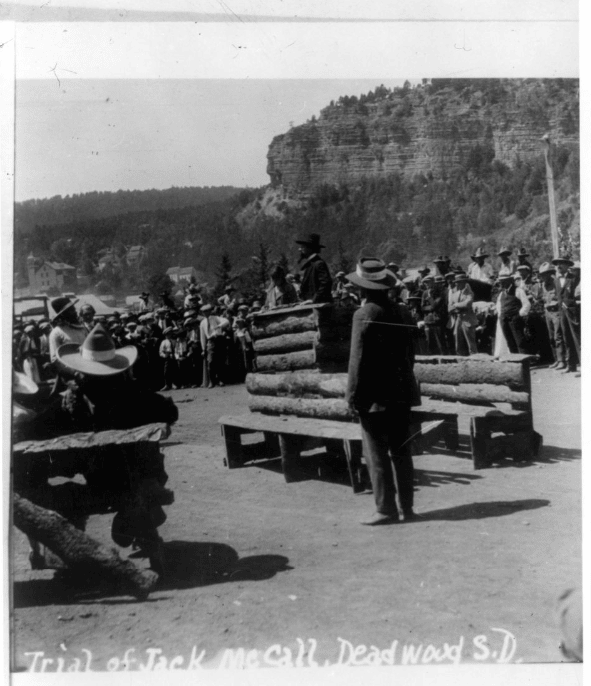
The following day, citizens of Deadwood—lacking a sheriff or a formal legal system—held a “miner’s trial” for McCall.
The trial took place in McDaniel’s Theater following a performance. There, McCall was appointed a defense attorney, Judge Miller, while Colonel George May represented the prosecution.
Judge William L. Kuykendall presided over the trial, and a jury of twelve men was selected from three mining districts in the area. Captain Massie, Charlie Rich, Carl Mann, and No. 10 bartender Harry Young all testified against McCall, who could supply no eyewitnesses in his defense.
Several defense witnesses, including McCall’s employer, spoke to the defendant’s character, but none had been present at the time of the murder.
Despite multiple eyewitness testimonies, the miner’s jury found McCall not guilty. Colonel May and others accused the jury of accepting bribes, as the evidence for cold-blooded murder appeared overwhelming, but McCall was released nonetheless.
Judge Kuykendall may have conducted the trial as best he could, but the sentiment at The Black Hills Pioneer was that McCall “was set free by a drunken and irresponsible group of men assembled as a jury for his trial.”
McCall stayed in Deadwood for a time, until Hickok’s longtime friend, California Joe Milner, who was out of town on August 2, suggested the mining camp wasn’t a safe place for the acquitted killer. McCall took the scout’s advice and left town, heading first to Cheyenne, and then, to Laramie City.
In Wyoming Territory, with a seemingly legitimate trial behind him, McCall had no problem bragging about the murder to whoever would listen. And on the night of August 29, 1876, the barroom audience included Colonel George May, the prosecuting attorney who’d followed McCall from Deadwood to Laramie, promising to bring the outlaw to justice.
Also present was deputy U.S. Marshal St. Andre Durand Balcombe, who rearrested McCall for the murder of Wild Bill Hickok.
Jack McCall’s Recapture
In the days following McCall’s second arrest, confusion surrounding his motive for killing Hickok grew. During his miner’s trial, McCall stated that Wild Bill had years ago killed McCall’s brother in Hays City, Kansas, and McCall was simply seeking revenge.
After his acquittal, however, McCall reportedly told more than one person that he killed Wild Bill over a card game. On August 30, the Cheyenne Daily Leader reported that McCall’s upcoming second trial would include a witness who:
…will testify that when McCall stopped at Horse creek, on his way to this city, he stated that Wild Bill never killed a brother of his, but that he killed Wild Bill merely because Bill snatched a card from his hand during the progress of a game between them.
Another newspaper claimed that McCall may have murdered another person after being acquitted of Hickok’s murder, as he showed up around Deadwood shortly after his trial “sporting a costly gold watch and chain, and had also a large sum of money.”
This also led to rumors that McCall had been hired to kill Wild Bill by Deadwood heavyweights who’d benefit from having the ex-lawman removed from the profitable lawlessness of the camp’s saloons and brothels.
Before Hickok’s death, biographer Joseph Rosa claimed, there were rumors that Hickok would be persuaded into becoming Deadwood’s first lawman.
By early September, it wasn’t clear if McCall murdered Hickok over a card game, a personal vendetta, or at the behest of someone in Deadwood. In his statement to newspapers, McCall claimed that Hickok had killed his brother and taken from McCall “some gold dust which he had as good as robbed me of in a poker game.”
What was apparent, McCall discovered, was that because his miner’s trial took place on the Great Sioux Reservation, his acquittal wouldn’t be recognized by U.S. authorities.
On October 18, McCall was indicted for murder in Yankton, the capital of Dakota Territory. He pleaded not guilty and confirmed that his real name was John McCall (his aliases also included Bill Sutherland).
Less than one month later, McCall and McCarty attempted their escape from the Yankton jail. When that failed, McCall turned to his next story, claiming that he had been hired to kill Hickok by John Varnes of Deadwood, who had a previous run-in with Wild Bill in Denver.
A deputy marshal and posse were sent to Deadwood in search of Varnes, who couldn’t be located. McCall also mentioned Tim Brady being involved in the plot, but Brady could also not be found.
If there was any truth to the idea that McCall was paid to murder Hickok, it couldn’t be corroborated.
Jack McCall’s Second Murder Trial
On the morning of December 4, Jack McCall’s second trial began in Yankton under Chief Justice Peter C. Shannon.
William Pound led the prosecution, and McCall’s defense attorneys were Oliver Shannon and General William H. Beadle. Pound called several eyewitnesses to the stand, including Carl Mann, George Shingle, and Captain Massie. J.B. Robinson was also called to describe McCall’s jailbreak attempt in November.
Wild Bill’s brother, Lorenzo Butler Hickok, watched the proceedings in the stands after arriving from Troy Grove, Illinois.
For their part, the defense called no witnesses, but did argue that they weren’t given a proper indictment—a motion that Judge Shannon overruled.
After three hours of deliberation on the night of December 6, the jury found McCall guilty of murder. On January 3, 1877, Judge Shannon sentenced McCall to hang on March 1. His attorneys appealed the conviction and set about finding their next strategy.
“He will carry the case to the Supreme Court,” the Cheyenne Daily Leader reported. “The only ground of defense is that he was intoxicated so as to be unconscious of the act.”
With his legal avenues dwindling, McCall and his defense team next appealed to the President for a pardon or commuted sentence.
Oliver Shannon organized a petition on McCall’s behalf that spoke to his character, and Dakota Territory Governor John L. Pinnington, a staunch opponent of the death penalty, signed it with confidence.
The appeal for a pardon rested on several factors, including the fact that McCall didn’t have any clear motive or previous criminal convictions. But the most disingenuous part of the petition suggested that McCall was simply the victim of the lawlessness of Deadwood itself.
Governor Pinnington wrote that the murder of Wild Bill took place during:
…a very early period in the history of the Black Hills, when pioneers, marauders, gamblers and all sorts of people common to new countries, were there, and all thus really in violation of law, and every man taking his chances — ‘Wild Bill,’ a notorious character, among them.
In reviewing the appeal, William Pound claimed that an “effort seems to be made now again, as it was on the trial, to excuse or palliate the act by a reference to the peculiar condition of society as then existed in the Black Hills.”
Instead of taking responsibility for the murder, then, McCall and his team now blamed the unruly conditions of the “boss city of the Hills.”
On February 19, 1877, U.S. Marshal Burdick—who prevented McCall’s escape from jail—received word from the Department of Justice that the Attorney General would decline to interfere with Judge Shannon’s sentence.
With no more legal loopholes to maneuver, McCall spent the remainder of February writing letters and visiting with Father John Daxacher. In one letter published in Cheyenne, McCall wrote to a friend in Denver:
You asked me if I thought it would pay to go to the hills in the spring. I think it would if you save your money and above all things let whisky alone.
This advice may be the real story of Jack McCall’s downfall in Deadwood. Perhaps the combination of losing money and pride to Hickok, along with strong whisky, led to his impulsive decision to kill the legend of the frontier.
Interestingly, during McCall’s Yankton trial, Captain Massie testified that he had seen McCall previously sneak up on Wild Bill in the No. 10:
I saw the defendant come into the same room a day or two before and around behind Bill and pull his pistol about two thirds out. There was a young man with him who put his arm around the defendant and walked him towards the back door.
If booze and a bruised ego drove McCall to murder Hickok, he never formally admitted it. In late February, McCall wrote to the editor of the Daily Press and Dakotaian, asking him to publish an article McCall would write before his death.
But the night before his hanging, McCall destroyed the article, robbing the public of the answers they sought. “Evidently he wished to hide, if possible, all traces of his past life,” wrote one newspaper.
Some details did come to light when McCall admitted that Mary McCall, who in February wrote from Louisville, Kentucky, was indeed his sister.
In a letter sent to Marshal Burdick, Mary claimed that John McCall had a “father, mother, and three sisters” who had not seen him in years, and wondered if he was the same man who killed Wild Bill.
There was no brother killed in Kansas, as McCall once claimed.
The Hanging of Jack McCall
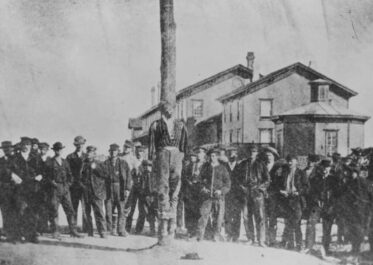
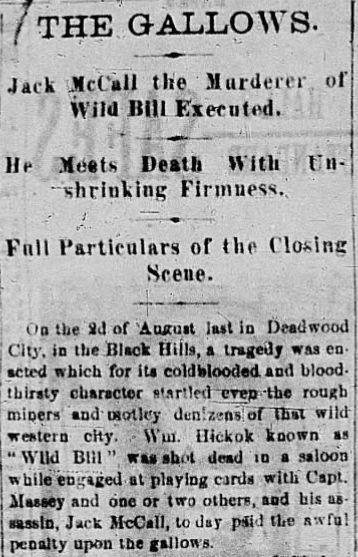
On March 1, Jack McCall was hanged by U.S. Marshal Burdick on a scaffold gallows near Yankton’s Catholic cemetery.
Some 500 onlookers were present to see the execution in which “McCall bore up with a remarkable nerve, and at no time showed the slightest indication of giving away,” reported the Lincoln County Advocate.
As Marshal Burdick adjusted the noose around McCall’s neck, the convict reportedly told him to “draw it tighter, marshal.” McCall was pronounced dead after hanging for twelve minutes and was buried in an unmarked grave in the Catholic cemetery.
In 1881, the cemetery was moved and McCall’s remains were exhumed. When his coffin was dug up, the Daily Press and Dakotaian reported “that McCall had been buried with the rope around his neck that strangled him.”
He was reburied, once again, in an unmarked grave in Yankton’s Sacred Heart Cemetery, where he lies today.
For McCall, who went under a number of aliases while in Deadwood, anonymity was a fitting end. Beginning in the summer of 1876, he shot and killed a man in the back, attempted to flee, and bragged about his exploits after leaving the territory following his acquittal.
He blamed the assassination on a non-existent brother, a contract killing, and the general lawlessness of Deadwood. He beat a jailor nearly unconscious, and when none of that worked, he asked the President to commute his sentence.
To the credit of his defense team, McCall explored as many legal loopholes as he could, but in the end, there was no denying that his actions in 1876 were anything but cowardly.
What Jack McCall wrote in the letter he hoped to publish after his death will never be known. But if it was anything like the last nine months of his life, it likely posed just as many questions as answers.
Sources
Books
- Clavin, Tom. Wild Bill: The True Story of the American Frontier’s First Gunfighter. St. Martin’s Griffin, 2019.
- Parker, Watson. Deadwood: The Golden Years. Bison Books, 1981.
- Rosa, Joseph G. They Called Him Wild Bill: The Life and Adventures of James Butler Hickok. University of Oklahoma Press, 1974.
Periodicals & Archives
- The Black Hills Pioneer (Deadwood, DT), August 1876.
- Cheyenne Daily Leader (Cheyenne, WY), August 1876 – January 1877.
- Daily Press and Dakotaian (Yankton, DT), November 1876 – March 1881.
- Lincoln County Advocate (Canton, DT), March 1877.
- South Dakota State Historical Society, Jack McCall Trial Records and Photography.
D.T. Christensen is the founding editor of OldWest.org, a history website committed to sharing and preserving stories of the American West. He was born and raised in Phoenix, Arizona, studied journalism at Northern Arizona University, and spent decades exploring the landscapes and history of the American West before moving to Massachusetts.