Cholera on the Oregon Trail: The Blue Scythe of Death
On April 3, 1849, 18-year-old Rachel E. Warren married Nathan Pattison, 23, in Randolph County, Illinois, just south of St. Louis. Just over a week later, the newlyweds joined Nathan’s family on their trek out west.
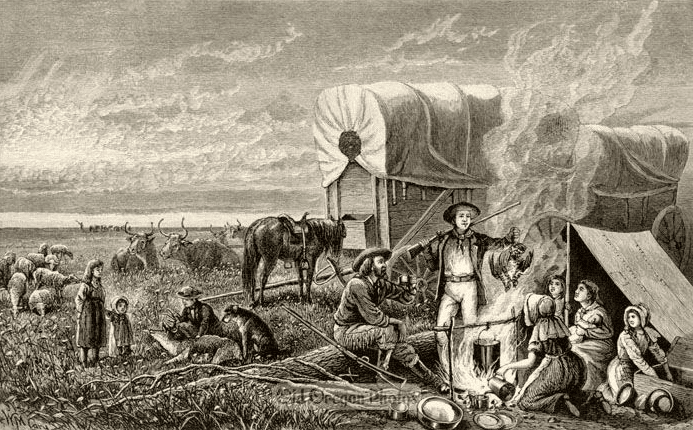
That year, tens of thousands of Oregon Trail pioneers would make the trip from Missouri—often jumping off at Independence or St. Joseph—across the plains of present-day Kansas and Nebraska, heading toward Oregon, California, Utah, or destinations in between.
The Pattison caravan included Nathan’s parents, William and Mary, Nathan’s five brothers, and some of his brother James’s family. The group of fourteen packed into three covered wagons and began their trip in mid-April.
Over the next six weeks, the Pattison party traversed the well-trodden Platte River route over the Great Plains that would later become the territories of Kansas and Nebraska.
On June 18, the Pattisons reached Ash Hollow, a lush, wooded area south of the North Platte River. Ash Hollow was a popular Oregon Trail landmark for emigrants in need of wood and water, and it’s often mentioned in overland diaries and journals.
“There are quite a large number of ash & cypress trees growing here from which it is named,” wrote traveler James Mason Hutchings in 1848.
When the Pattisons arrived, William planned to repair their wagons and adjust the party’s remaining oxen. On Monday, June 18, Rachel was in fine health, but on the following morning, she began to feel ill.
Within twelve hours, Rachel Pattison was dead.
In his diary, William wrote:
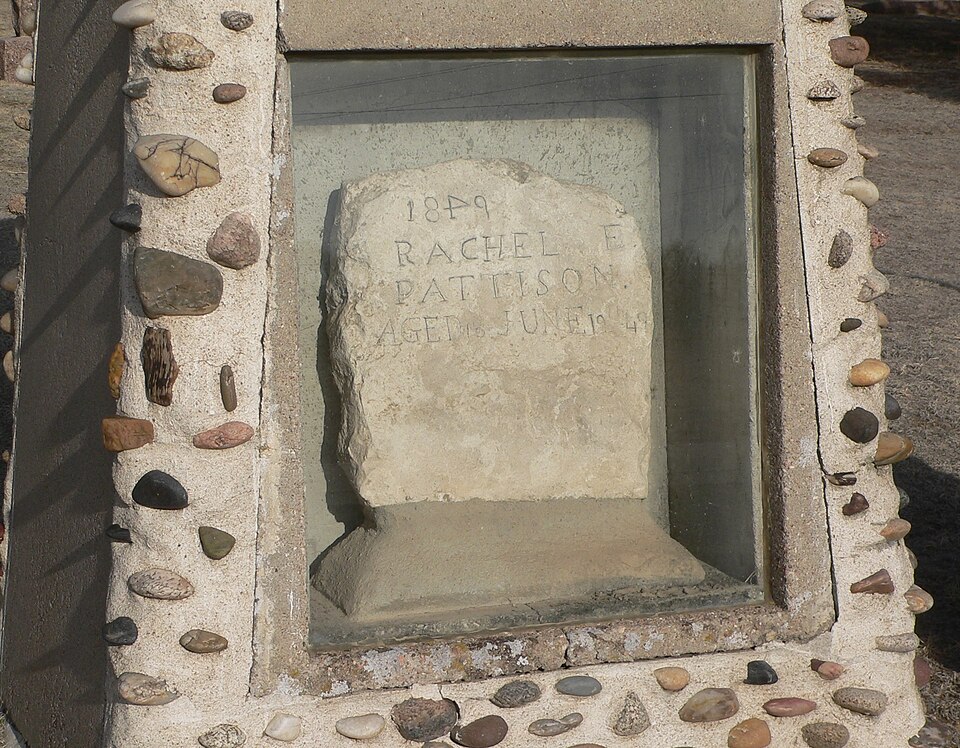
…next day our Company left us about 11 ocl Rachel was taken with Colara and died by 11 at night of 19 instant Medical aid was obtained from a train from Mechigan of the Dr Ormsby after burying on the left side of the hollow as you go round the bluff up the River on the second bank placing a grave stone at her head Rachel Pattison aged 18 June 19th 1849.
Nathan, grieving his wife of less than three months, kept his journal entry even simpler. “Rachel taken sick in the morning, died in the night,” he wrote.
Rachel was buried nearby, and Nathan etched the most basic details of her life into stone before the Pattisons picked up the trail toward the Pacific Northwest.
Rachel was one of thousands of emigrants who died from cholera along the trails heading to Oregon, California, and Utah in the 1840s through the 1860s.
Her story and the swiftness with which she passed—sick in the morning, dead at night—was a familiar occurrence on the plains, particularly in 1849, when cholera reached its disastrous peak.
Cholera on the Overland Trails
Of all the maladies on the emigrant trails, none were as common, sudden, or devastating as cholera. The gastrointestinal illness arrived quickly, spread like wildfire, and could wreak havoc on entire caravans within hours or days. Life on the Oregon Trail was tedious, to be sure, and cholera made the journey excruciatingly more difficult.
In The Ox Team: Or, The Old Oregon Trail 1852 To 1906, Ezra Meeker recounted how a passing traveler told him of a family grave on the trail:
A family of seven persons, the father known as ‘Dad Friels,’ from Hartford, Warren county, Iowa, all died of cholera and were buried in one grave. He could not tell me the locality nor the exact date, but it would be useless to search for the graves, as all such have long ago been leveled by the passing of the hoofs of the buffalo or domestic stock, or met the fate of hundreds of shallow graves, desecrated by hungry wolves.
Often, travelers or entire families were infected before it was obvious that anyone was sick. Although the risks of cholera were well-known, its causes were still unclear in the late 1840s and early 1850s, leading to a number of ineffective remedies and unchanged traveling habits that continued to spread the illness across the Platte River valley and beyond.
It wasn’t until 1854 that British doctor John Snow discovered that a water source in London— the Broad Street pump—was infecting locals after it had been contaminated by leakage from a nearby cesspool. The doctor’s findings confirmed that cholera spread through contaminated water.
But in 1849, the popular theory was that cholera spread through air particles and was especially prevalent in filthy areas. In places like New York, Boston, and New Orleans—growing city centers with often inadequate sanitary systems—this certainly could be the case, but that didn’t always explain why small settlements on the open plains also became infected.
Transmission of cholera may have been misunderstood, but this much was clear: in 1849, a perfect storm of conditions came together to spread the illness hundreds of miles across the young United States, from the bustling port of New Orleans to the frontier outpost of Fort Laramie on the Northern Plains.
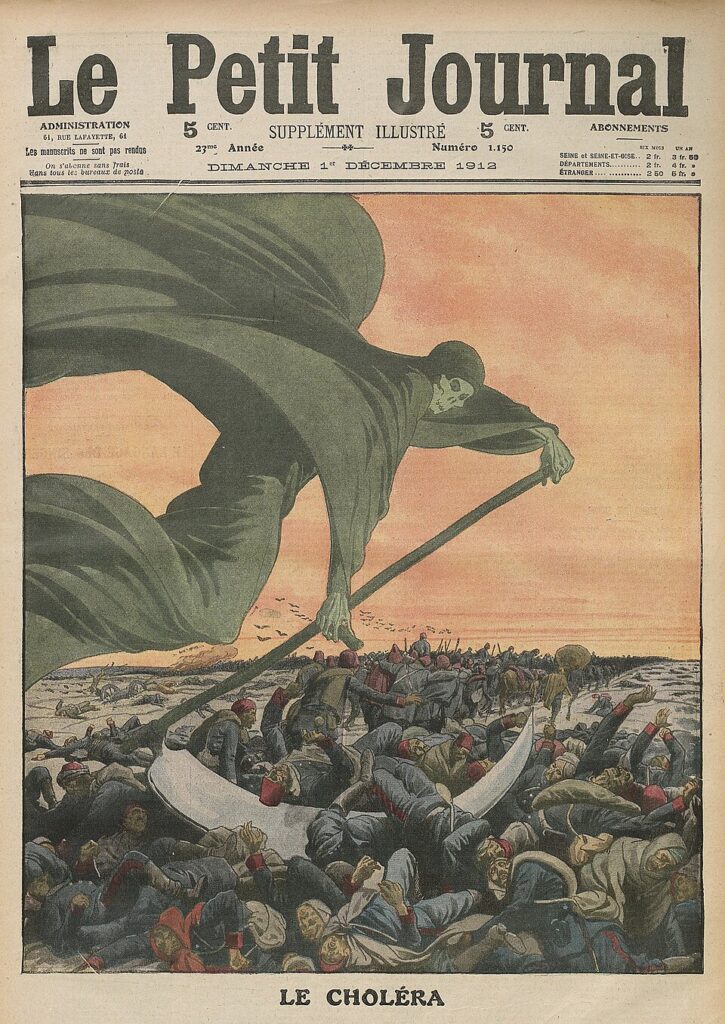
The scythe of death went to work on a nation looking optimistically to the West.
Cholera Arrives from Europe
In December 1848, immigrant ships from Germany—and perhaps England—arrived in New Orleans with rats and passengers carrying cholera.
“In the mild New Orleans December, the disease spread rapidly among the unwashed and weary immigrants,” wrote Charles E. Rosenberg in The Cholera Years: The United States in 1832, 1849, and 1866.
It didn’t take long for the illness to make its way up the Mississippi River, infecting small river ports until it reached St. Louis, home to more than 60,000 people—and a steady steam of travelers.
On January 4, 1849, The Missouri Whig reported:
It is now in N. Orleans, and great numbers are leaving the city. From the number of cases on board every boat that has left that city in the last few days, we would not be surprised that the disease is raging there to a greater extent than might appear from any report of the Health Officer that has yet reached us. On several of the boats destined for St. Louis, a number of deaths have occurred.
This was not the first time cholera had reached the United States. In the early 1830s, British trade ships brought the disease from the Ganges River valley of India—thought to be cholera’s 1817 origin—to Canada. From there, it swept down into New York and throughout the U.S.
This was considered part of the second global cholera pandemic, and hundreds of thousands were killed worldwide. The disease reached the Pacific coast in North America, but because overland travel wasn’t as extensive, cholera mainly affected populated ports like New York.
But in 1849, overland travel was a different story.
Thousands of people had trekked west throughout the early 1840s, and the 1848 discovery of gold in California meant even more travelers set their sights on the West. It’s thought that at least 25,000 to 30,000 emigrants hit the overland trails in 1849 alone.
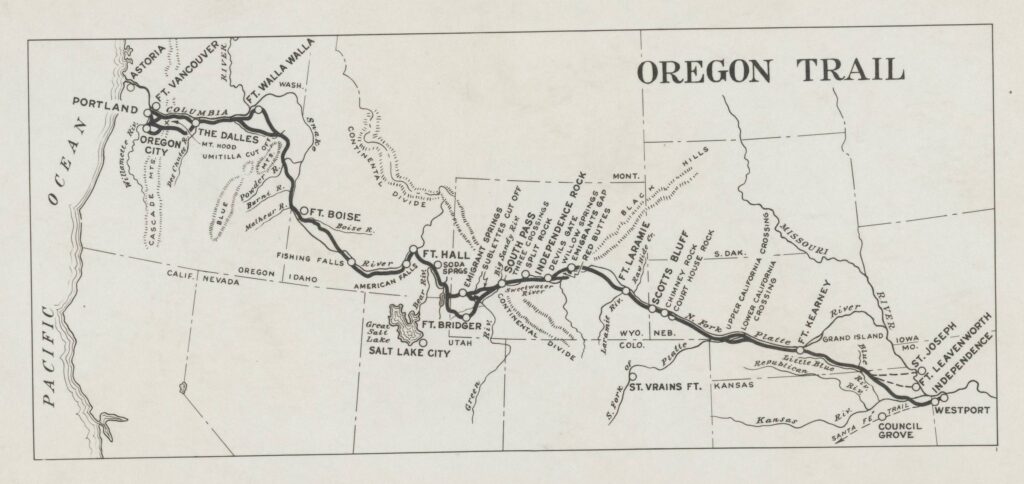
When cholera hit St. Louis, then, it didn’t take long to spread to overland trail “jumping off” points like Independence and St. Joseph, both on the Missouri River.
As prospectors, farmers, families, entrepreneurs, and others prepared for their overland travels, cholera spread throughout the river towns, infecting and killing hundreds of emigrants before they had a chance to depart.
Travelers on riverways were just as susceptible, wrote Major Osborne Cross in March of the Regiment of Mounted Riflemen to Oregon in 1849:
It will not be out of place to remark here that the cholera was not only in St. Louis, but had spread through every town on the Missouri river. In many instances [it] had raged with great violence on board several steamers, one of which, after losing nearly thirty passengers, was entirely abandoned and left tied to the shore.
Throughout 1849, newspapers and diarists reported on the status of cholera in various towns and outposts in Missouri, describing the ebbs, flows, and waves the disease seemed to move in.
“Cholera has broken out afresh in St. Louis,” wrote one traveler. “It has subsided at Independence but ‘is said to be making fearful devastations on the plains.'”
Cholera Moves West
From Missouri, cholera moved west with its hosts, and the first third of the Oregon Trail—the stretch between Independence and Fort Laramie—soon became known as the “Trail of the Dead.”
Journalist Charles F. Lummis described the disease’s movement in those years:
In the Fifties the Asiatic Cholera crawled in upon the Plains, and like a gray wolf followed the wagon trains from the ‘River’ to the Rockies. In the height of the migration, from 4,000 to 5,000 emigrants died of this pestilence; and if there was a half-mile which the Indians had failed to punctuate with a grave, the cholera took care to remedy the omission.
In truth, cholera was far more deadly than the potential for Native American attacks. “We feared the Cholera more than we did the Indians,” wrote Louisa Anne Bozarth in 1852, “for we knew if we got that, it meant death.”
Of course, it’s difficult to get an exact count of how many travelers died on the trails due to cholera, but it was undoubtedly in the thousands. In 1849 alone, more than 4,000 people in St. Louis died from the disease.
“It is estimated that about one-third of the entire population of the city had either left or fell victims to disease,” reported Missouri’s Glasgow Weekly Times in July 1849.
Counting the city’s dead was challenging, but a death toll on the emigrant trails proved even more difficult to assess. Many deaths went unreported or were attributed to other causes and ailments.
Estimates vary widely, but it’s thought that between 1840 and 1869, between 300,000 and 500,000 emigrants traveled the routes leading from Missouri to Oregon, California, and Utah. One contemporary expert, Dr. Peter D. Olch, estimated that 55,000 emigrants attempted the journey in 1850 alone.
He estimated “that the overall mortality rate of those heading west was 6 percent but an accurate figure is very difficult to determine.”
Using those and similar figures, between 20,000 to 30,000 emigrants may have died on the overland trails. There’s no telling how many of those were due to cholera, but historians agree that cholera was the leading cause of death on the journey west.
In Journal of the West, Roger P. Blair wrote:
The number of deaths from cholera on the overland trek West can never be accurately known; estimating losses from diary accounts or reminiscences is inherently difficult. But from an historical perspective, the number that died during the 1849–1854 epidemic is less important than recognizing that the number was great and that the risk faced by the embarking emigrants was immense.
Spread over the 2,000-plus miles of the Oregon Trail, that number of dead would leave some 10 to 15 graves per mile across the plains and mountains.
Because cholera appeared to mostly affect the first third of the trip, however, there may have been stretches where far more than ten graves dotted the landscape of each mile.
If they were marked at all, graves may have been accompanied by piles of rocks, simple wooden crosses, or even the tailgate of a wagon, where cholera may have been burned into the wood or written in axle grease.
Others were more creative. The grave of 50-year-old Rebecca Winters, who died of cholera on August 15, 1852, near Scotts Bluff, is marked by a bent metal wagon wheel rim with her name and age etched into its frame.
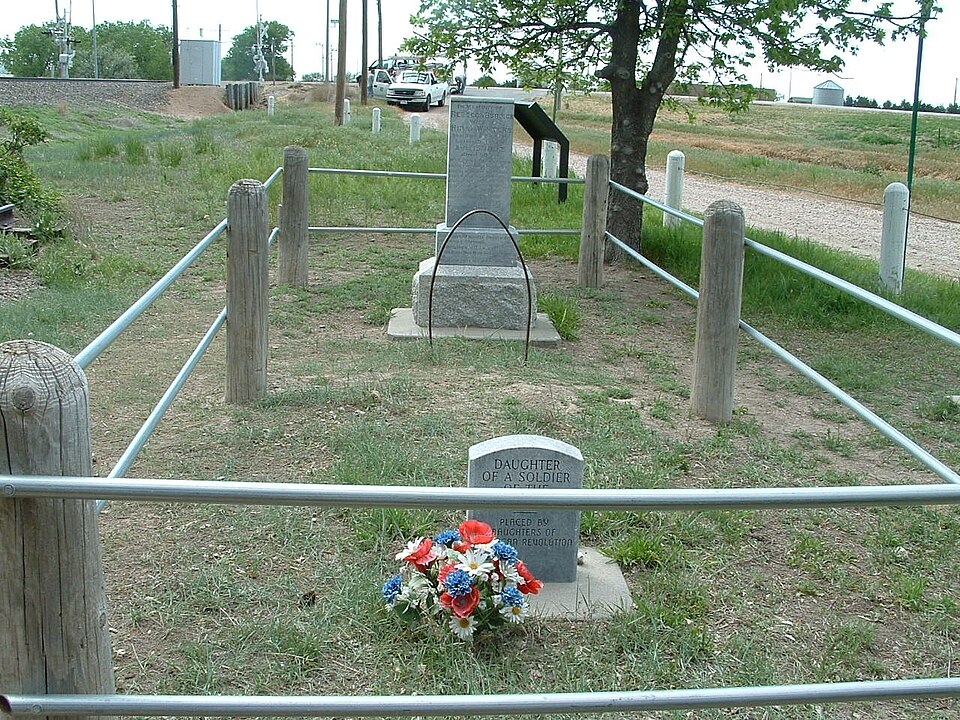
Some trailside graves were set back from the main roads (there wasn’t a single “trail,” but rather a network of braided routes that could change based on weather, land conditions, and the availability of resources), while others were placed directly in the path of oncoming livestock and wagons.
Trampled grounds could prevent animals from digging into shallow graves much better than loosely placed rocks could.
Back in Missouri, travelers were warned of the sickness sweeping the plains, but those who had sold farms, lands, personal goods, and businesses to finance their move west had little choice but to move forward.
They would take their chances with the “unseen destroyer” on what was quickly becoming a miles-long graveyard across the Great Plains.
How Overland Travelers Experienced Cholera
Cholera is a gastrointestinal illness caused by the bacterium Vibrio cholerae, which affects the small intestine’s ability to absorb water, electrolytes, and nutrients.
The toxic bacteria breaks down the small intestine’s lining and leads first to severe, watery diarrhea. This discharge is sometimes called “rice water stools” because of its gray or beige color and consistency.
Diarrhea and other symptoms may not appear for hours or days after someone’s been infected with cholera, which may have made it difficult to determine where exactly it was contracted on the overland trails.
If a family on the Oregon Trail was traveling at a good clip, they may have been infected at a watering hole 15 miles away or more before they began to show visible symptoms.
This may have added to the mystery of cholera, as it appeared to “strike suddenly, with no warning, often killing the victim within hours of the first symptoms,” wrote historian Robert W. Carter.
The diarrhea caused by V. cholerae was so severe and watery that it could deplete up to 10 percent of a person’s weight in just hours. According to the Mayo Clinic, choleric diarrhea can release about a quart or a liter of fluids per hour, so if it was left untreated, the discharge could quickly become fatal.
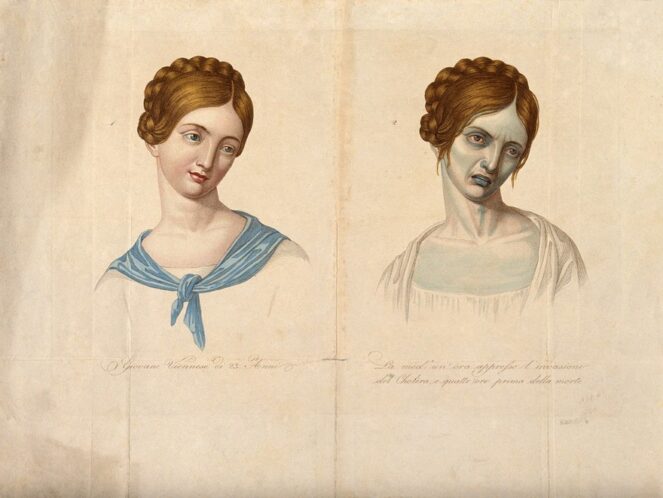
Such a rapid loss of liquids inevitably led to muscle cramps, vomiting, sunken eyes and facial features, loss of skin elasticity, and other symptoms that come with swift dehydration.
Victims would become weak and dizzy, complaining of thirst and a rapid heartbeat. Kidney failure, uremia, and sepsis were common as cholera decimated its victims.
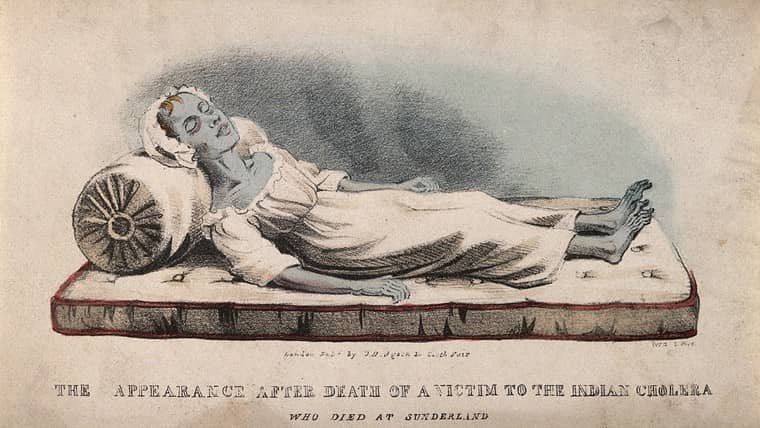
In its later stages, cholera could cause the skin to turn a blue or purple hue (cyanosis), lending the illness its “blue death” moniker. Although diarrhea may not sound like the worst way to die, it was a far more violent death than one might imagine.
Wrote historian Sarah Keyes:
Cholera contorted and convulsed the bodies of its victims with such force that hips displaced from their sockets, nimble fingers froze into contorted claws, and life-sustaining fluids drained from veins. This final feature of cholera’s pathology resulted in the blackening or bluing of the bodies of cholera’s victims. The effect of this ghastly transformation was that many cholera victims became corpse-like before they actually became corpses.
The mental stress of enduring cholera was likely just as horrific. In his overland journals, Major Osborne Cross described one man’s frightening experience:
By this time the man who had the cholera became entirely deranged and required the strength of one person to keep him in the wagon. His sufferings were very great and his cries most distressing, particularly as it was not in our power to render him any assistance or relief.
Cholera could kill within hours or days, and Rachel Pattison’s 12-hour cycle of sickness was not uncommon. Often, if a victim survived the first 24 hours of cholera, they had a good chance of recovering.
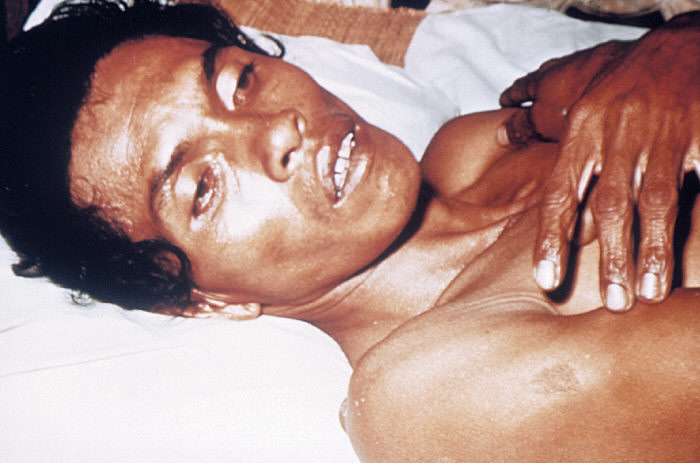
Today, the CDC estimates that the fatality rate for untreated cholera victims is between 25 and 50 percent. It’s more severe in sensitive populations, like children or the elderly, or those with existing health issues.
It’s easy to see how such a fatal, fast-moving disease could wipe out entire caravans of travelers on the overland trails. For those who did survive, it was likely a long road to recovery, especially if clean water was still hard to come by.
In July 1850, one traveler wrote:
Cholera broke out in every train in Plum Creek valley from June 1, to June 7. The correspondent counted forty graves in sixty miles. Long list of dead. On June 7, about fifteen miles west of Plum Creek, were three wagons with only one man able to sit up; originally twelve; six dead and buried; four dying of cholera, one had measles, and the other was well but could scarcely stand from fatigue.
Cures for Cholera on the Oregon Trail
Once cholera struck on the trails, treatment options were limited and mostly ineffective. Today, the treatment for cholera is simple: urgent oral or intravenous rehydration with fluids, electrolytes, and salts. With proper treatment, cholera’s fatality rate today drops to about 1 percent.
On the Oregon Trail in the mid-19th century, however, the solution wasn’t as obvious or accessible. After all, it was contaminated water that often caused cholera, so finding clean water to replenish lost liquids was challenging.
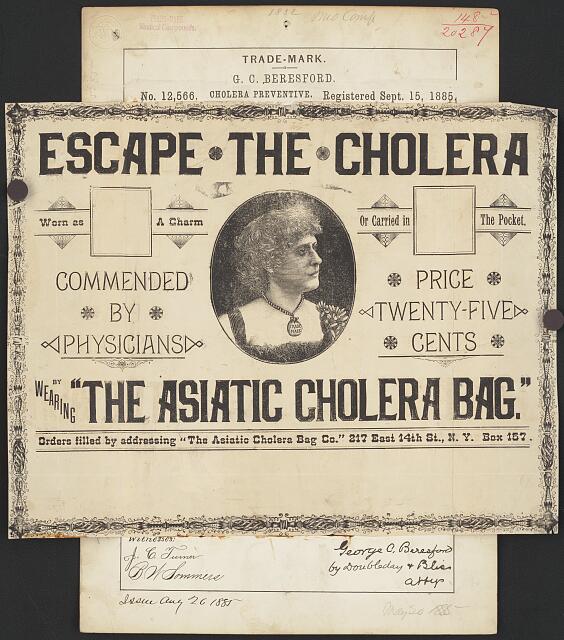
Instead, travelers turned to a number of supposed treatments, including laudanum—a common opium tincture—calomel, capsicum, cayenne pepper, or various “drops” touted by doctors and newspapers.
In 1850, traveler James Abbey aided a fellow emigrant suffering from cholera:
I found him in his tent, with a buffalo skin on the cold ground for his bed, and a blanket to cover him. Upon inquiry I found he was suffering from a diarrhoea which he was unable to check. Having some of Forwood’s cholera drops, I gave him a large dose, which relieved him immediately. I staid with him some three hours, and left him much better.
Most treatments weren’t remedies so much as ways to dull the excruciating pains of cholera. In 1849, proper treatment of the illness wasn’t fully understood because it still wasn’t clear how exactly it spread. But that didn’t stop anyone from speculating.
How Cholera Spread on Emigrant Trails
Today, it’s well-known that cholera spreads by water and food contaminated with the Vibrio cholerae bacterium, which can be found in feces for up to ten days after infection.
One of the most common ways it spread on the emigrant trails, then, was when there wasn’t a proper divide between human waste and the preparation of food and water.
A family camping at a popular emigrant stop on a river might relieve themselves, wash their laundry, and prepare their meals all in the same general area of a riverbank or watering hole, just as the family before them had.
When thousands of emigrants did the same over several months, it’s easy to see how the bacteria—which can lay dormant in water for long periods—could spread from one caravan to the next. An infected party could then carry it to the next camping spot and start the process anew.
Working off trail guides and accounts from past travelers, emigrants often stopped at the same spots for water, good grass, and wood, meaning cholera could proliferate in some key places more than others.
It was known that much water wasn’t clean on the trail—long stretches of the Platte River had alkaline riverbanks and marshes that required boiling water before drinking it—but it wasn’t obvious that cholera spread there as well.
Boiling water was a common practice, wrote Frank McLynn in Wagons West, but not necessarily as an antidote to cholera:
Alkaline water was corrosive and made people sick, more severely polluted liquid could bring on typhoid, while the sparse waterholes in the desert were often crawling with infusoria and noisome with bison urine, which could cause dysentery and cholera.
Instead, countless theories attempted to explain the causes of cholera, both in cities and on overland trails.
Newspapers of the time ran lengthy articles from doctors and others who proposed that the illness was caused by any number of factors, including: poor climate, excess moisture, drinking alcohol, living in filth (which was partly true), living in sin, lacking fresh air, living at the ground level of cities (again, possibly partially true), and even living with a general sense of fear, grief, anger, or “mental distress.”
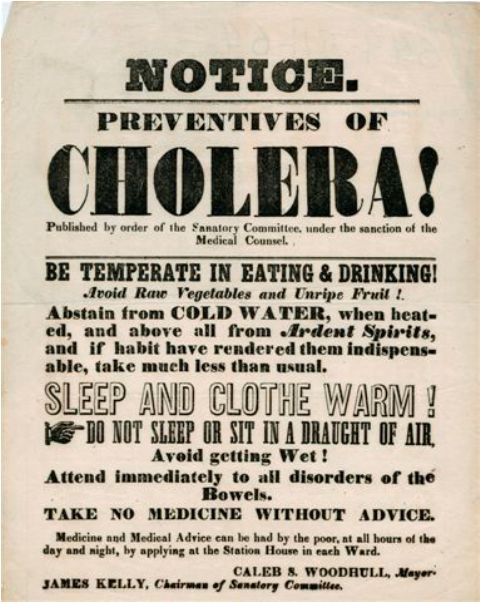
“There can be no doubt that thousands have fallen victims to fear during the prevalence of cholera,” reported The Missouri Whig in January 1849. “Fear is a depressing passion; and when long continued, it so greatly subdues the vital energy, that the weakened system becomes an easy prey to the prevailing disease.”
Because cholera often broke out in filthy areas of large cities that lacked proper sanitation and sewer systems, it was long considered “a physical manifestation of defective morality.”
By 1849, however, it was clear the disease wasn’t relegated to the impoverished: on June 15 of that year, former President James K. Polk died from cholera after contracting it while traveling in the South.
In cities, on ships, or over the Great Plains, cholera could spread quickly anytime human waste came into contact with drinking water sources or food.
But another factor may have made cholera on the emigrant trails even more fatal: the overland diet. The lack of healthy food options on the trail may have led to many travelers having poor digestive systems, making cholera more pronounced.
In The Ox Team, Ezra Meeker wrote:
Some trains, it soon transpired, were without fruit, and most of them depended upon saleratus [early baking soda] for raising their bread. Many had only fat bacon for meat till the buffalo supplied a change, and no doubt but much of the sickness attributed to the cholera was caused by an ill-suited diet.
This observation was surprisingly accurate. In a 2008 article from the American Clinical and Climatological Association, one researcher stated:
I think that the reason why cholera is endemic in many parts of the world is because of undernutrition and achlorhydria and hypochlorhydria. It is a disease of the disadvantaged. It is a disease of the poorly nourished.
Overland travelers may not have been impoverished—they had to have enough supplies and funds to make the trek west—but it does stand to reason that restricted diets could affect the health of their digestive systems, even temporarily.
This, then, was the perfect storm that coalesced in 1849: overland transportation was on the rise, cholera was still misunderstood, and diet-related health issues may have made emigrants more susceptible to the illness.
The Effect of Cholera on Indigenous Populations
Inevitably, it wasn’t just Anglo emigrants who were affected by the wave of cholera. Indigenous peoples across the Great Plains also suffered, including the Kiowa, Sioux, Pawnee, Cheyenne, Comanche, Arapaho, and other plains tribes.
“We learn that the Indians are dying off very fast of the cholera at Bellevue, on the opposite side of the river, so much so that they have left their dead unburied,” reported a Council Bluffs newspaper in July 1849.
It’s believed that “virtually no tribe on the Plains escaped the 1849 epidemic,” but the Pawnee were particularly devastated by cholera, as they lived in the direct path of the Oregon Trail that cut through present-day Kansas and Nebraska.
A Pawnee Indian agent in 1849 reported that “two hundred and fifty [Pawnee] men and nine hundred women and children have fallen victims of cholera.” Some estimates claim that the Pawnee may have lost as much as 25 percent of their total population during peak cholera years.
During the Kiowa’s annual sun dance in the summer of 1849, cholera spread quickly as numerous tribes came together to celebrate. In the Kiowa’s historical calendar, that summer’s gathering is known as Mayiagyu’ K’ddo, or the “Cramp Sun dance.”
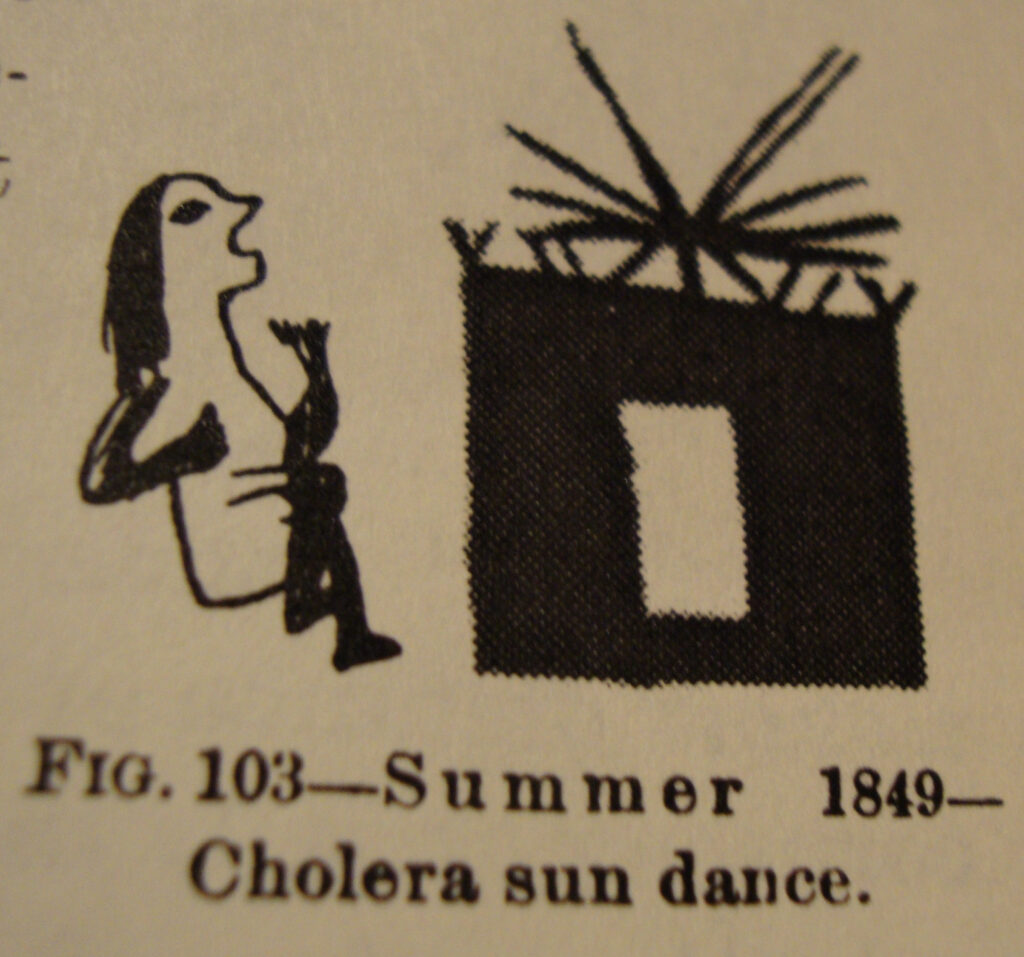
After the event, according to a Bureau of American Ethnology report, the illness spread throughout Kiowa camps as they dispersed:
The Kiowa say that half their number perished during its prevalence; this is probably an exaggeration, but whole families and camps were exterminated and their tipis were left standing empty and deserted.
The Cheyenne and other tribes likely had similar experiences, and it’s feasible that Indigenous people experienced thousands of cholera casualties across the Great Plains during peak Oregon Trail years. Tribes may have eventually avoided emigrant trails to avoid catching the disease.
“Indians will be scarce on the road this year—afraid of cholera,” wrote one overland traveler in June 1850.
Cholera Today
In modern times, cholera continues to crop up in regions where sanitation systems are inadequate.
The CDC estimates that 1 to 4 million cases of cholera occur every year, and in January 2024 alone, the World Health Organization reported 40,900 cases and 775 fatalities in 17 countries, including Zambia and Zimbabwe.
Fortunately, cholera, when treated, is significantly less fatal now than it was in 1849. Back then, the mysterious stomach illness seemed to come and go as it pleased, sparing some families and travelers while decimating others.
Sadly, thousands of cholera victims—settlers and Indigenous peoples—along the Oregon Trail went to graves that were just as invisible as their cause of death.
Most hastily dug and constructed burial sites along the trail from Missouri to Fort Laramie were damaged by scavenging animals, harsh weather, and the grinding passage of time and changing landscapes.
But several graves still exist to tell the story, including those of Rachel Pattison in Ash Hollow, Rebecca Winters near Scotts Bluff, Nancy Jane Hill in western Wyoming, George Winslow in Jefferson County, Nebraska, and Alvah Unthank near Glenrock, Wyoming.
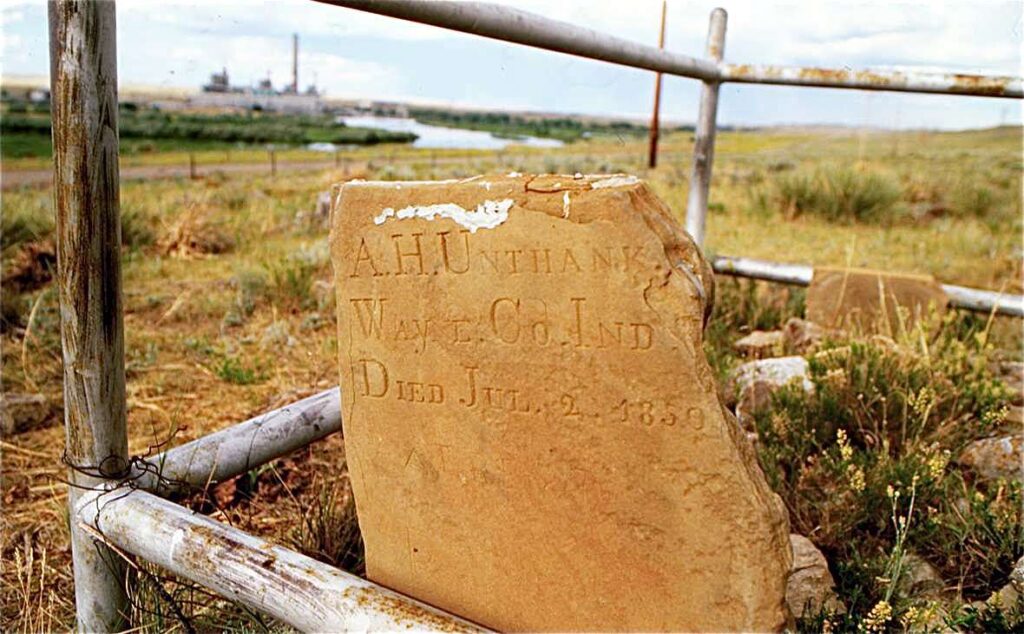
Pattison, Hill, Winslow, and Unthank were all under 25 when they died, just beginning to build their lives when they headed west.
Cholera’s “unseen destroyer” nickname wasn’t just hyperbole: it dismantled lives, families, and plans for the future, leaving countless victims without so much as a marked grave.
The illness would continue to haunt the overland trails well into the 1860s, when yet another global pandemic broke out after the Civil War.
But in 1849 through 1852, as hopeful emigrants followed the Platte River toward their futures, the grim scar of cholera left a legacy upon the Great Plains that could not be forgotten, however invisible its ravages.
Sources & Further Reading
- Buck, Rinker. The Oregon Trail: A New American Journey. Simon and Schuster, 2015.
- Carter, Robert W. “‘Sometimes When I Hear the Winds Sigh’: Mortality on the Overland Trail.” California History 74, no. 2 (1995): 146–61. https://doi.org/10.2307/25177489.
- Centers for Disease Control and Prevention. “Cholera – Vibrio Cholerae Infection,” n.d. https://www.cdc.gov/cholera/index.html.
- Contagion – CURIOSity Digital Collections. “Cholera Epidemics in the 19th Century,” n.d. https://curiosity.lib.harvard.edu/contagion/feature/cholera-epidemics-in-the-19th-century.
- Cross, Osborne. March of the Regiment of Mounted Riflemen to Oregon in 1849. Ye Galleon Press, 1967.
- Daly, Walter J. “The Black Cholera Comes to the Central Valley of America in the 19th Century – 1832, 1849, and Later.” PubMed, January 1, 2008. https://pubmed.ncbi.nlm.nih.gov/18596846.
- Eligon, John, and Jeffrey Moyo. “Deadliest Cholera Outbreak in Past Decade Hits Southern Africa.” The New York Times, February 13, 2024. Accessed February 15, 2024. https://www.nytimes.com/2024/02/13/world/africa/cholera-outbreak-zimbabwe-zambia-malawi.html.
- Hartman, Amos William. “The California and Oregon Trail, 1849-1860.” The Quarterly of the Oregon Historical Society 25, no. 1 (1924): 1–35. http://www.jstor.org/stable/20610264.
- History Nebraska. “Marker Monday: Ash Hollow,” May 22, 2023. https://history.nebraska.gov/marker-monday-ash-hollow/.
- Keyes, Sarah. “Western Adventurers and Male Nurses: Indians, Cholera, and Masculinity in Overland Trail Narratives.” Western Historical Quarterly 49, no. 1 (2018): 43–64. https://www.jstor.org/stable/26782936.
- Meeker, Ezra. The Ox Team: Or, The Old Oregon Trail, 1852-1906; an Account of the Author’s Trip Across the Plains, from the Missouri River to Puget Sound, at the Age of Twenty-two, with an Ox and Cow Team in 1852, and of His Return with an Ox Team in the Year 1906, at the Age of Seventy-six. United States: E. Meeker, 1907.
- National Historic Oregon Trail Interpretive Center. “History Bits & Westward Quotes on the Oregon Trail,” n.d. https://www.blm.gov/sites/blm.gov/files/learn_interp_nhotic_quotes.pdf.
- National Park Service. “Cholera: A Trail Epidemic,” n.d. https://www.nps.gov/articles/000/cholera-a-trail-epidemic.htm.
- National Park Service. “Rachel E. Pattison Grave,” n.d. https://www.nps.gov/places/000/rachel-e-pattison-grave.htm.
- National Park Service. “Rebecca Winters’ Grave,” n.d. https://www.nps.gov/places/winters-grave.htm.
- OCTA. “Life and Death on the Oregon Trail – OCTA,” March 29, 2018. https://octa-trails.org/articles/life-and-death-on-the-oregon-trail/.
- Olch, Peter D. “Treading the Elephant’s Tail: Medical Problems on the Overland Trails.” Bulletin of the History of Medicine 59, no. 2 (1985): 196–212. https://www.jstor.org/stable/44441831.
- O’Neil, Tim. “A Look Back: The Day St. Louis Buried 88 Victims of the Cholera Epidemic.” St. Louis Post-Dispatch, July 18, 2023. https://www.stltoday.com/news/archives/a-look-back-the-day-st-louis-buried-88-victims-of-the-cholera-epidemic/article_f50b669f-a4c8-595b-bc6a-d3d9833ffc14.html.
- Powers, Ramon, and James N. Leiker. “Cholera among the Plains Indians: Perceptions, Causes, Consequences.” The Western Historical Quarterly 29, no. 3 (1998): 317–40. https://doi.org/10.2307/970577.
- Publications of the Nebraska State Historical Society. United States: Nebraska State Historical Society, 1922.
- Rigby, Jennifer, and Gloria Dickie. “Cholera Vaccine Stocks ‘empty’ as Cases Surge.” Reuters, February 14, 2024. https://www.reuters.com/business/healthcare-pharmaceuticals/cholera-vaccine-stocks-empty-cases-surge-2024-02-14/.
- Rosenberg, Charles E. The Cholera Years: The United States in 1832, 1849, and 1866. University of Chicago Press, 1987.
- Rushton, Patricia. “Cholera and Its Impact on Nineteenth-Century Mormon Migration.” Brigham Young University Studies 44, no. 2 (2005): 123–44. http://www.jstor.org/stable/43044444.
- Smithsonian Institution. Bureau of American Ethnology. Annual Report of the Bureau of American Ethnology to the Secretary of the Smithsonian Institution, 1895.
- Smithsonian American Art Museum. “The Gold Rush and Westward Expansion,” n.d. https://americanexperience.si.edu/wp-content/uploads/2015/02/The-Gold-Rush-and-Westward-Expansion.pdf.
- Southern Oregon History, Revised. “James Mason Hutchings, 1848-49,” April 25, 2016. https://truwe.sohs.org/files/hutchings1848.html.
- The Library of Congress. “The Forty Niners,” n.d. https://www.loc.gov/collections/california-first-person-narratives/articles-and-essays/early-california-history/forty-niners/.
- “The Oregon Trail,” n.d. http://netwagtaildev.unl.edu/nebstudies/en/1800-1849/routes-west/the-oregon-trail/.
- Tuite, Ashleigh R., Christina H. Chan, and David N. Fisman. “Cholera, Canals, and Contagion: Rediscovering Dr Beck’s Report.” Journal of Public Health Policy 32, no. 3 (2011): 320–33. http://www.jstor.org/stable/20868815.
- University of Leeds. “Cholera,” n.d. https://library.leeds.ac.uk/special-collections/collection/2159.
- World Health Organization: WHO. “Cholera,” July 1, 2019. https://www.who.int/health-topics/cholera.
Accessed via newspapers.com
- The St. Joseph Weekly Gazette, November 3, 1848
- The Missouri Whig, January 4, 1849
- The Weekly Courier-Post, January 4, 1849
- The Weekly Courier-Post, April 12, 1849
- Columbia Herald-Statesman, May 4, 1849
- Columbia Herald-Statesman, June 15, 1849
- Columbia Herald-Statesman, June 29, 1849
- Glasgow Weekly Times, July 5, 1849
- The Frontier Guardian, July 11, 1849
- Columbia Herald-Statesman, July 13, 1849
- The Burlington Hawk-Eye, July 19, 1849
- Columbia Herald-Statesman, July 20, 1849
- The Western Watchman, September 20, 1849
D.T. Christensen is the founding editor of OldWest.org, a history website committed to sharing and preserving stories of the American West. He was born and raised in Phoenix, Arizona, studied journalism at Northern Arizona University, and spent decades exploring the landscapes and history of the American West before moving to Massachusetts.


_Pattison_marker.JPG)

_on_the_Mormon_Pioneer_National_Historic_Trail_(2002)_(37c0e56b-835c-4f5b-92fc-1a3d092890fb).JPG)

