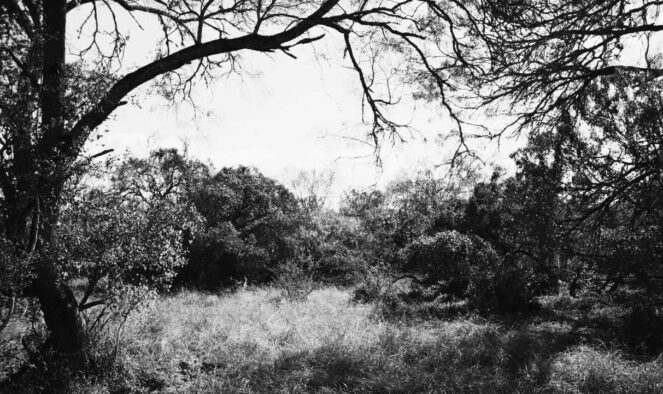
Late in the summer of 1863, a horse trader named John Savage rode through the warm, tree-scrubbed lowlands of south Texas.
He had recently sold horses to the Confederate Army, and now, with $600 worth of gold in his saddlebags, Savage rode south toward Corpus Christi, or perhaps Matamoros, Mexico, where more horses could be gathered and sold to the Confederacy.
Savage followed a branch of the Cotton Road, a network of trails and backroads used by the South to transport cotton and other commodities during the Civil War.
As the conflict progressed and Union forces began to blockade critical ports in the South, the Cotton Road was devised as a way to continue shipping and selling cotton to international markets like Mexico.
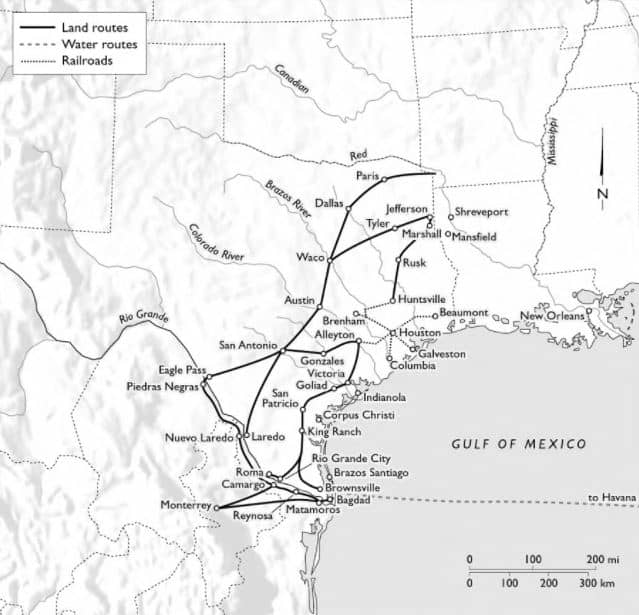
The Cotton Road began in east Texas and wound down to Matamoros on the southern side of the Rio Grande. Savage was likely familiar with the route, and after leaving Goliad the previous day, knew he’d eventually approach the Aransas River south of Refugio.
On the west bank of the Aransas, he’d find a modest traveler’s inn operated by an older Mexican woman named Josepha (Josefa) Rodriguez.
Chipita Rodriguez
Josepha, also known as “Chepita” or “Chipita,” lived in a small cabin on the river, where she offered weary travelers warm meals and a place to sleep on the road to San Patricio. Hers was a humble abode, but for trail-worn John Savage, it was a welcome upgrade from his many nights on the road.
Chipita, who traced her lineage back to the Aztecs of northern Mexico, came to Texas in the 1820s when her father, Pedro Rodriguez, fled the tyrannical rule of Antonio López de Santa Anna.
Chipita’s mother died early in their journey, and Pedro died years later while fighting during the Texas Revolution, leaving Chipita to care for herself on the quickly changing frontier.
She met a cowboy, the rumors claim, and bore him a son, but the man took the child and left Chipita with nothing.
How she acquired a cabin on the Aransas is lost to history, but there may have been a land grant from the Mexican or Spanish government in her family’s name. She may also have simply occupied the land and remained unbothered until the summer of 1863.
Savage soon arrived at Chipita’s inn, and according to her own account, he promptly took care of his horse, ate his meal, and retired for the night. At dusk, she went for a quiet walk along the Aransas while her guest settled in.
In the days following Savage’s arrival, as the story goes, two slaves from the nearby ranch of John Welder went to the Aransas River to collect firewood or wash the laundry.
There, they spotted what appeared to be burlap gunny sacks filled with something heavy. The mass was lodged near shore, and when they brought it to the bank and opened it up, they immediately called for John Welder.
When Welder arrived at the river, he opened up the sacks to find the body of John Savage. The corpse was water-logged, and it appeared as if his head had been split wide open by an ax.
“His pockets yielded a few coins, tobacco, matches, and a pocketknife,” wrote Keith Guthrie in The Legend of Chipita. “Whether Savage was buried on the river where he was found or taken to a burying place on the ranch, no one knows.”
That day, Welder rode 15 miles to Meansville to retrieve San Patricio County Sheriff William B. Means. The men didn’t know it at the time, but the death of John Savage would lead to one of the most controversial legal cases in early Texas history.
The Murder of John Savage
As Sheriff Means began his investigation of the murder, it became clear few people had seen Savage in his final days. Although the San Patricio Road was well-traveled, the long distances between ranches and stopping points typically made for a solitary journey.
Means discovered that Savage had been carrying $600 in gold after selling horses to Confederate soldiers, so the sheriff assumed he had been robbed and then murdered. In those turbulent days, small towns in south Texas had to contend with “roving bands of Mexican soldiers, gringo bandits, and cattle rustlers,” wrote Guthrie. A trailside murder for gold wasn’t inconceivable.
Eventually, Means’ investigation led to the inn of Chipita Rodriguez, who appeared to be the last person to see Savage alive. Chipita was an “elderly woman” of indistinguishable age (she was likely in her sixties) and by all accounts, was small, frail, and weighed less than 100 pounds.
Chipita professed her innocence, and no murder weapon was found near the inn or river. When the sheriff pointed out a blood stain on her porch, Chipita claimed it belonged to a chicken she had earlier butchered.
Sheriff Means arrested Chipita and a man named Juan Silvera, nicknamed Juan Chiquito, whom Means suspected was her accomplice.
Means brought the two to his own home in Meansville, and as the legend goes, he may have fought off two separate lynch mobs interested in enacting their own version of frontier justice.
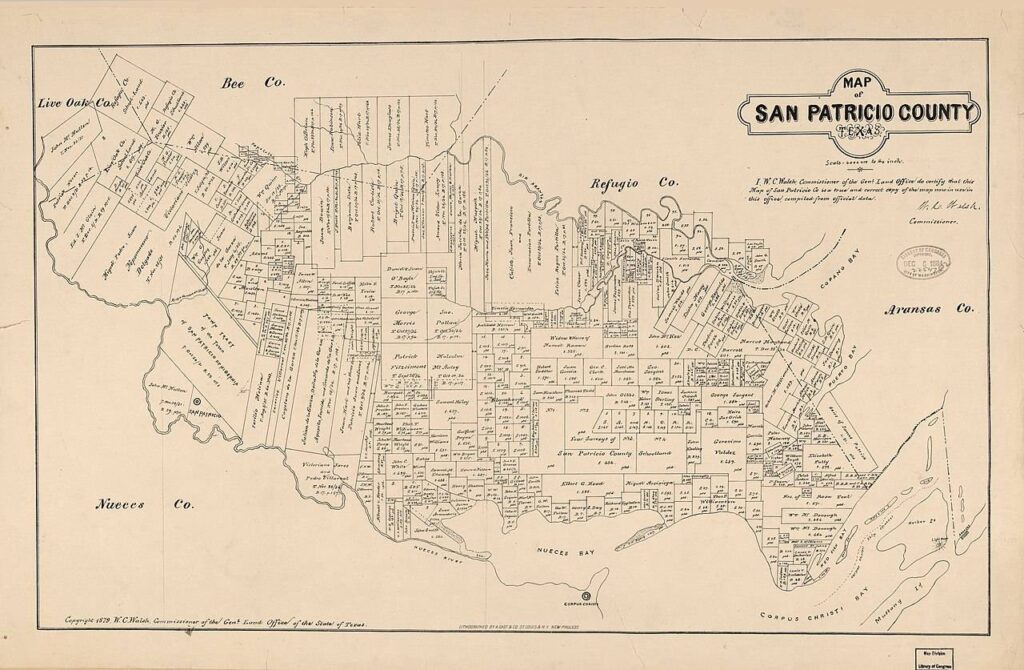
Chipita and Silvera were eventually taken to San Patricio De Hibernia, the county seat founded in 1829 when two Irish empresarios, James McGloin and John McMullen, brought some 200 Irish Catholic families to Texas with approval from the Mexican government.
The San Patricio courthouse jail had no “bars” to speak of, so Chipita was placed in leg irons and arm shackles during her confinement. Her cell contained little more than a wooden box and a “pile of quilts” for bedding.
In late 1863, San Patricio was feeling the economic and emotional effects of the Civil War: many of their young men had volunteered to join the Confederate cause, and the town feared an invasion by the Union Army—a concern many small communities in Texas shared.
So when Chipita and Silvera were indicted for murder charges on October 7, tensions in the region were high, and uncertainty plagued San Patricio’s citizens. The trial started two days later, and it was immediately apparent that this would not be a conventional legal proceeding.
For one, the lack of men in San Patricio meant that some of the jurors selected for the case were themselves in town to face criminal charges, including cattle rustling—which was rampant in the county—and even murder. Three members of the grand jury also served on the petit jury that would eventually decide Chipita’s fate.
Sheriff Means was conveniently named the foreman of the grand jury, which determined the pair would indeed face murder charges, and he would also testify against the defendants during the trial. Owen Gaffney, a county justice of the peace, served as the trial jury foreman.
The motive behind the murder had also been debunked. Before the trial started, Savage’s saddlebags filled with the $600 were found “lodged in an eddy of the lazy-flowing river,” which meant the prosecution couldn’t argue Chipita robbed the trader for his gold.
According to most accounts, Chipita, who spoke little English, said only “not guilty” in her own defense (“No soy culpable“). Though she had two public defenders in Pat O’Docharty and William Carroll, they offered little help. Juan Silvera allegedly testified against Chipita, perhaps as a way to “lighten his own sentence,” Guthrie wrote.
The Trial of Chipita Rodriguez
Chipita’s trial was mostly a formality, and on the day of jury deliberation, it didn’t take long for foreman Gaffney to return their verdicts. Juan Silvera was found guilty of second-degree murder and sentenced to five years of labor at a state penitentiary.
Gaffney read the ruling for Chipita, who had spent days languishing in a poorly constructed jail cell at the San Patricio courthouse:
We the jury find the defendant Chepita Rodriguez Guilty of murder in the first degree but on account of her old age and the circumstantial evidence against her do recommend her to the mercy of the court.
Chipita’s public defenders initially claimed they’d file a motion to appeal, but soon reconsidered, and Chipita wasn’t able to have her conviction reviewed.
The “mercy of the court,” then, would be decided by Fourteenth District Judge Benjamin F. Neal, an attorney, politician, and newspaperman who served as Corpus Christi’s first mayor from 1852 to 1855.
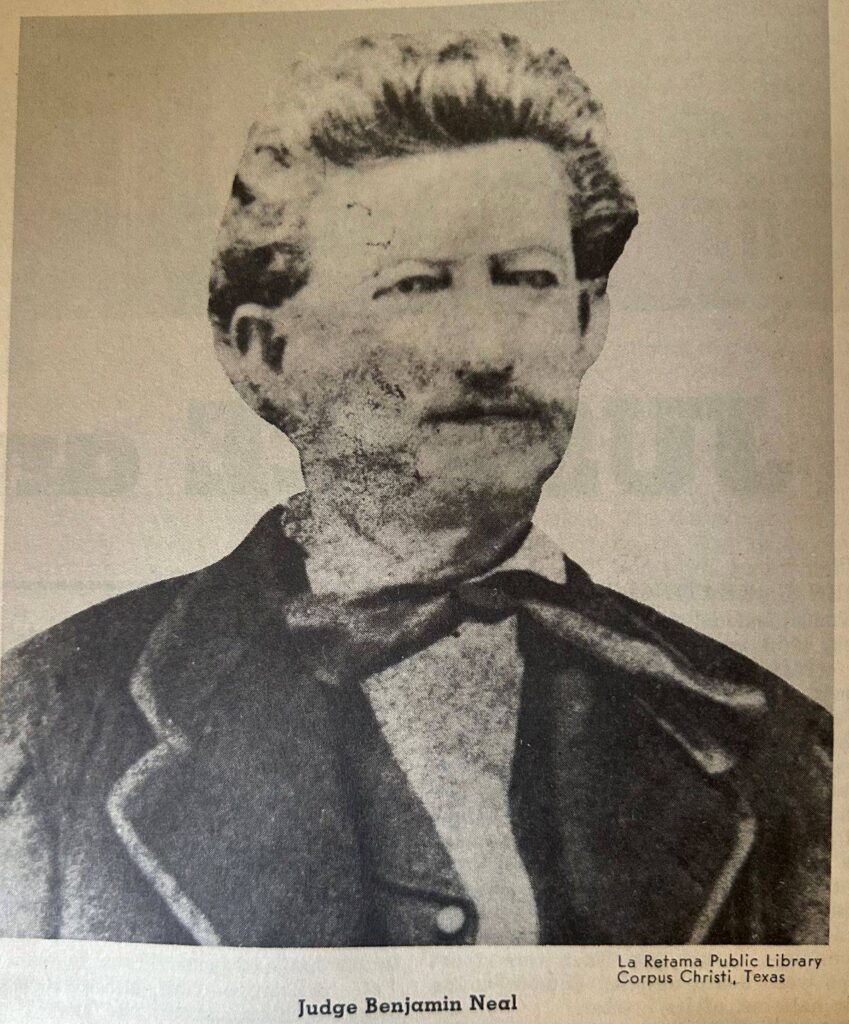
Neal had been elected as a judge in a special election held earlier that year. In 1862, as a temporary panel judge in the Confederate military, Neal found a treasonous soldier guilty and sentenced him to death.
Now, in October 1863, Judge Neal, who had shown he was “a man capable of administering the death penalty,” sentenced Chipita Rodriguez to be hanged between 11 a.m. and sundown on Friday, November 13, 1863. The reaction was stunning, wrote Guthrie:
Silence engulfed the tiny courtroom. Chipita stood frozen before the judge. It was as if the listeners were waiting for something else to happen. Stories passed down from family to family in Old San Patricio seem to indicate that the bulk of the populace (especially the women and children) thought that the judge would heed the admonishment of the jury when they petitioned for mercy from the court due to ‘Chipita’s old age’ and the ‘circumstantial evidence.’
Despite flimsy evidence and a hastily organized trial full of questionable jury members, Chipita was to become one of the first women legally hanged in Texas.
Early accounts claim she was the first and last woman lawfully hanged in the state, but according to the Texas State Historical Association, a slave named Jane Elkins was legally hanged for murder in Dallas on May 27, 1853.
According to some accounts, Judge Neal’s less-than-merciful sentence was an attempt to make Chipita confess to knowing who murdered Savage, whether it was Juan Silvera or someone else entirely. Because of Chipita’s age and physical condition, it’s likely many of the jurors acknowledged that it would be difficult for her to overcome and murder a strong, frontier-hardened trader like Savage.
If that was the judge’s strategy, it didn’t work. Chipita remained steadfast in her silence, and a wave of sympathy for the woman swept through the community of San Patricio. Children brought her cookies, treats, tobacco, and corn husks to roll cigarettes in her courthouse cell.
Before Chipita was hanged, the Sullivan sisters, Eliza and Rachel, brought her a new dress, braided her hair, and prepared her a basin of warmed water. It was the least they could do in the face of what appeared to be a clear miscarriage of justice.
The Hanging
On Friday, November 13, 1863, the town of San Patricio was cloaked in an overcast gloom. Sheriff Means was out of town, possibly delivering Silvera to the state prison to begin his sentence, so the task of preparing to hang Chipita Rodriguez fell to Deputy John Gilpin.
That day, Gilpin requested the use of a two-wheeled cart from Kate McCumber, who brazenly responded, “Not in my wagon!” The women and children of San Patricio may have been unable to save Chipita from her fate, but they didn’t want to participate in the spectacle any more than necessary.
Gilpin finally procured a cart, brought it to the courthouse under the strain of two oxen, and hoisted Chipita into the back, where she sat on a recently made coffin. Gilpin guided the cart west out of town toward a spot near the Nueces River where the woman would be hanged.
Most accounts agree that Chipita was hanged from a mesquite tree—one that was a month later struck by lightning—though others say it was an old oak tree on the river’s bank. If the legend holds true, whatever tree it was died the following month and was cut up into firewood. Today, it’s unknown precisely where Chipita was hanged.
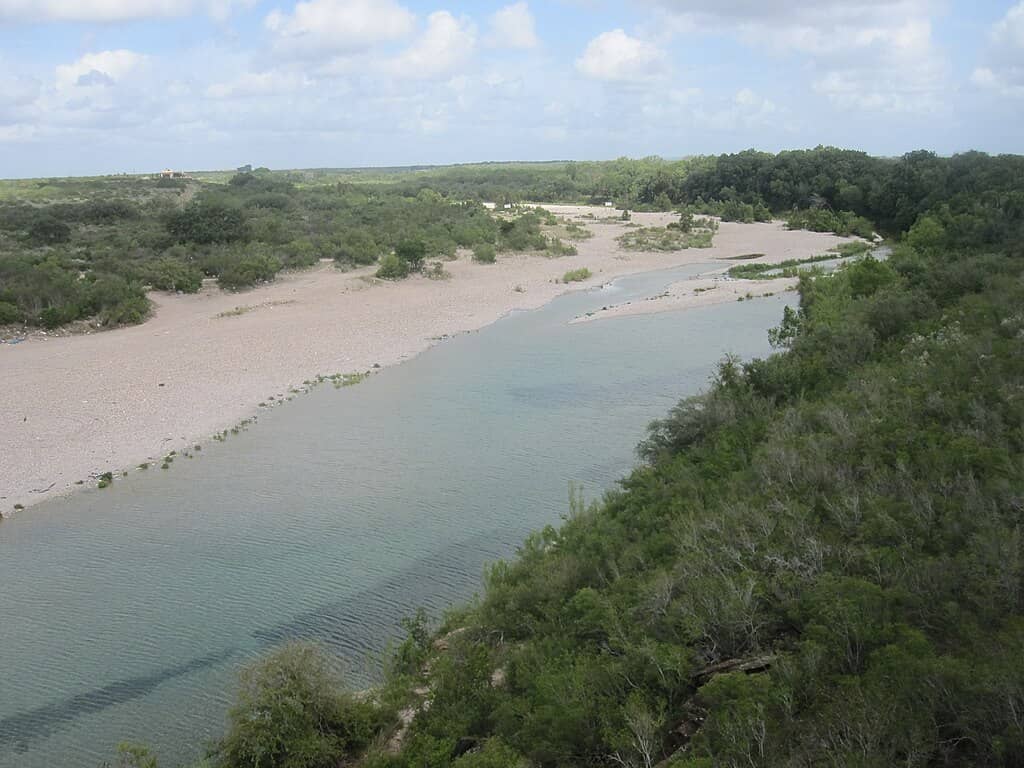
At the river, Deputy Gilpin tied Chipita’s hands where her shackles had once been, and some stories say he either forgot a face cover, or offered a handkerchief that she may have refused.
Gilpin placed the noose around Chipita’s neck, and she stood at the back of the cart. The rope was thrown above a tree branch and tied to the trunk, and with a quick whip, the oxen heaved forward. Chipita’s body soon dangled from the rope, and because she was so light, the hanging didn’t break her neck but instead strangled her.
“There was no cover on her face to blot out the horrors of strangulation,” one witness later recalled.
She was buried nearby, and some rumors claim Gilpin himself had to dig the grave because no one else would help with the task. He would later move away from San Patricio after it was made clear he was no longer welcome there.
At this point in her tale, Chipita became a supernatural legend: one witness recalled hearing the woman stir in her coffin as it was lowered into the ground.
“I heard a thump and a subsequent groan issuing from the coffin,” the witness recalled. “I did not stop running until I reached home, which was at least a mile.”
The town of San Patricio De Hibernia—founded by hardy settlers of devout Catholic faith—hanged and buried an elderly woman outside of the town cemetery, in an unmarked grave near the river, and without the wake or rites that usually accompanied one in death.
To superstitious locals, the hanging foretold doom for the town and its citizens. Though the community flourished briefly following the Civil War, by 1890, there were only a few hundred residents left in San Patricio.
What Really Happened to Chipita?
The story of what really happened to Chipita Rodriguez in the summer and fall of 1863 is largely unknown. A fire burned down San Patricio’s courthouse in 1889, destroying any trial records that may have existed. In his extensive research, author Keith Guthrie tracked down a number of personal letters and oral stories surrounding Chipita’s death, but even those are a motley of rumor and hearsay.
According to local stories, on the night before Chipita was hanged, Kate McCumber—the woman who refused to give her cart to Deputy Gilpin—visited Chipita and brought her a warm meal. Chipita, who had remained silent throughout her trial, allegedly confessed to Kate what actually happened the day John Savage was murdered.
McCumber claimed that after a walk along the river, Chipita returned to her cabin to see a man “stooping over a prostrate body on the ground.” The man, Chipita claimed, turned out to be her long-lost son, whom she had not seen since his father took him away many years ago. The son left quickly with Savage’s horse, and Chipita called on nearby ranch hand Juan Silvera to help her dispose of Savage’s body.
Chipita swore McCumber to secrecy, and it wasn’t until decades later that Kate told of what she’d heard in the San Patricio courthouse that night. Over the years, the story evolved and took on new forms: in some versions, Juan Silvera was her son, or even her lover, and in nearly all stories, there’s a sense that Chipita purposely covered for whoever murdered John Savage, whether that was her son, Silvera or herself.
Why Chipita received such an unfair trial is also unknown. Although murder charges were common in San Patricio County, an actual indictment and guilty verdict was not, especially for a case built on such circumstantial evidence.
Theories suggest Chipita was being forced off her valuable land near the Aransas River, or that she may have been working to collect sensitive political information along the Refugio-San Patricio Road during a critical time in the Civil War.
Whatever the reason, it’s clear Chipita didn’t receive the right to a fair trial as was guaranteed to American citizens by the Sixth Amendment.
For years, the story of Chipita’s trial and hanging was confined to local lore. Residents of San Patricio passed on the story to each generation, and in the 1940s, teacher and poet Rachel Bluntzer Hebert wrote a poem called “The Hanging of Chepita Rodriguez,” containing the lines:
More than all the luminous shadows Which the natives vow have hovered Near this dying gallows tree Since the fall of sixty-three— Shadows which rise when dusk has covered All the river and wooded bottoms. Then on stormy nights they mention How a wail invites attention.
In 1990, Keith Guthrie published The Legend of Chipita, and over the years, her name came up whenever Texas considered executing a woman, like Karla Faye Tucker, who died by lethal injection on February 3, 1998, for murdering two people in 1983.
In the 1980s, San Patricio County attorney Richard Hatch reignited interest in Chipita’s case. Within a few years, Hatch and Texas State Senator Carlos Truan created a resolution to exonerate Chipita of her conviction.
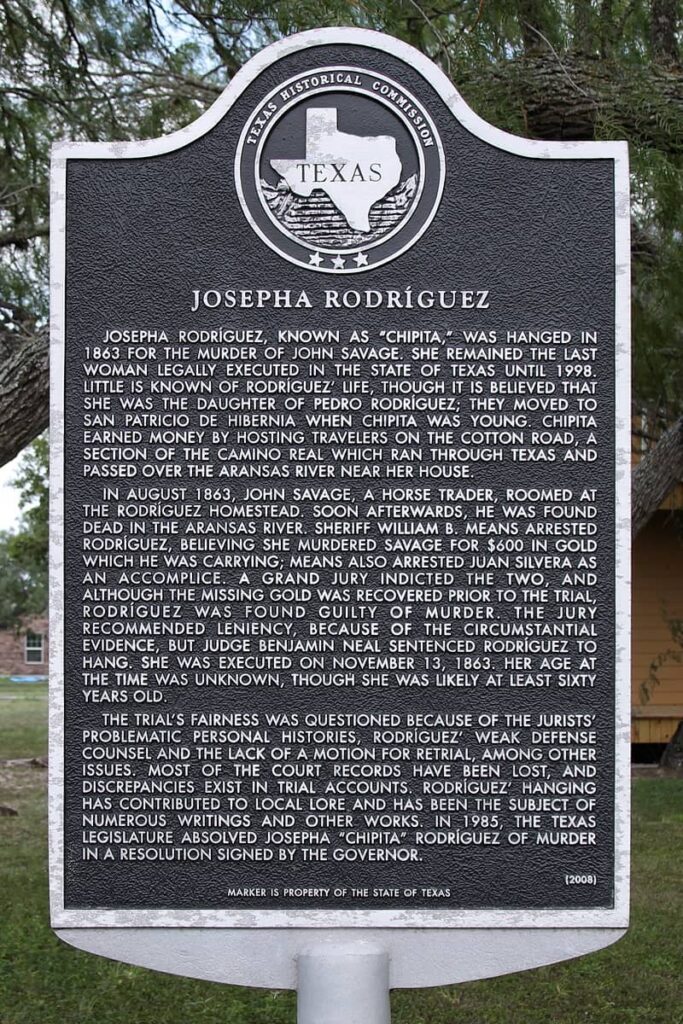
The 1985 bill pointed out the “apparent irregularities” of Chipita’s trial, which “even for 19th century Texas, was highly unusual.” The resolution was signed by Governor Mark White in June 1985 and “concluded that she did not receive a fair trial and hence was executed without benefit of due process of law.”
It was a small but meaningful acknowledgment of the injustice done to Chipita Rodriguez more than 120 years prior.
“We will never really know if she was guilty or innocent of the murder of John Savage, [but] we do know that she did not receive a fair trial,” said Senator Truan.
Today, a historical marker in downtown San Patricio honors the woman who faced a chilling fate near the Nueces River on that somber day in November 1863. The exact details of Chipita Rodriguez’s hanging may fade with time, but her legend will echo through the annals of Texas folklore for generations to come.
Sources & Further Reading
- The Legend of Chipita: The Only Woman Hanged in Texas, Keith Guthrie
- “The Day Texas Hanged a Woman,” Dee Woods, Real West, November 1966
- “The Curse That Killed San Patricio Town,” Ruel McDaniel, Old West, Winter, 1968
- Forgotten Colony: San Patricio De Hibernia: The History, the People and the Legends of the Irish Colony of McMullen-McGloin, Rachel Bluntzer Hebert
- 1985 Senate Resolution re: Chipita Rodriguez
- Historical Marker Database
- “A black day in San Patricio when Chipita was hanged,” Murphy Givens, Corpus Christi Caller-Times, January 17, 2017
- Chipita Rodriguez, Texas State Historical Association
- San Angelo Evening Standard, November 13, 1953
- Corpus Christi Caller-Times, June 27, 2018
- El Paso Times, June 12, 1960
- El Paso Times, February 2, 1964
- Corpus Christi Caller-Times, March 11, 2015
- The Paris News, January 28, 1998
D.T. Christensen is the founding editor of OldWest.org, a history website committed to sharing and preserving stories of the American West. He was born and raised in Phoenix, Arizona, studied journalism at Northern Arizona University, and spent decades exploring the landscapes and history of the American West before moving to Massachusetts.


https://shorturl.fm/qCbrD
Hello would you mind stating which blog platform you’re using? I’m looking to start my own blog in the near future but I’m having a difficult time deciding between BlogEngine/Wordpress/B2evolution and Drupal. The reason I ask is because your design seems different then most blogs and I’m looking for something completely unique. P.S My apologies for being off-topic but I had to ask!
Oopbuy Spreadsheet is a free shopping-agent spreadsheet and product finder for cross-border shoppers. The oopbuy spreadsheet ? aggregates thousands of curated finds — with photos, prices and working agent links — so buyers can compare items ? across popular Chinese shopping agents
Oopbuy Spreadsheet
Nieuwste adult websites brengen innovatieve inhoud voor volwassen entertainment.
Ontdek veilige nieuwe platforms voor een moderne ervaring.
Here is my webpage; BUY CIALIS ONLINE