Old West Hangings: The Grim Ritual of Frontier Justice
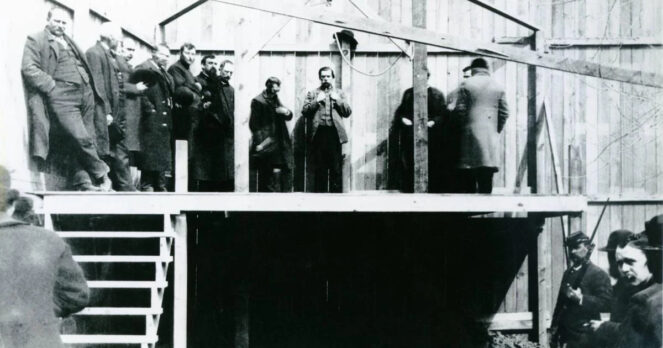
Many settlements in the West may not have been as violent as movies often depict them to be, but murders and other serious crimes were undoubtedly committed, and public hangings were sometimes the end result of the judicial process playing out on the frontier.
Unlike lynchings, which were often done under cover of night and at the hands of vigilantes, legal public hangings were standardized and conducted in a way to execute the condemned person as efficiently as possible.
For townspeople, a public hanging was a unique social event.
According to Hal Preece, who was a young boy when outlaw Henry Brock was hanged in his town, “the public hanging ranked on the same level with the Saturday night dance in the social life of the early West.”
In later years of the West, invitations to a hanging were sometimes passed out to prominent locals. A particularly noteworthy hanging with limited viewership might even lead to counterfeit invitations.
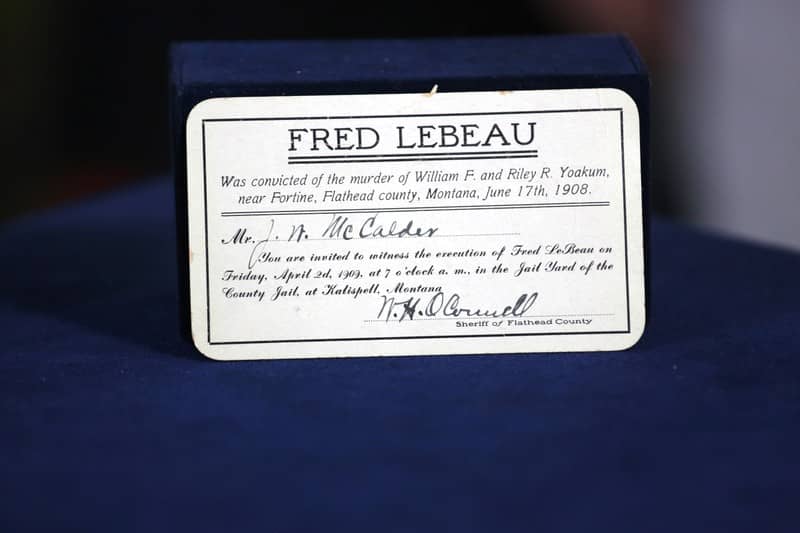
On invitations to the 1899 hanging of George Smyley in Arizona, Sheriff Frank Wattron “displayed shocking taste” when he noted that the execution would “be conducted according to the latest art of strangulation,” and would be “as cheerful as possible.”
Hanging Day
On “hanging day,” people from around the area would travel into town, taking advantage of the opportunity to shop and socialize while awaiting an execution that was often scheduled at noon. Storekeepers would benefit from the influx of business before closing shop to attend the hanging themselves.
Men, women, and children were all welcome at public hangings.
“Though considered macabre today, children were especially invited to such events because executions were educational tools to show them the consequences of wrongdoing,” wrote Dino E. Buenviaje in Invitation to an Execution: A History of the Death Penalty in the United States.
Of course, not everyone was on board with the morbid public displays. A letter to the editor of The Seattle Post-Intelligencer in 1894 described one woman’s disapproval of public hangings:
Once I was in a state capital where there was a public hanging. Although only two blocks away, I did not see it. But there were many hundreds of people, men, women and children, came from all parts of the surrounding country, on foot, on horseback and in wagons, many of them arriving a day beforehand, so as to be sure to be on hand to see the murderer die. It was a time of drunkenness and carousing. The solemn fact that the law executed the criminal in expiation of his crime was entirely lost sight of in the insane curiosity to see if the victim died game.
As the time of hanging approached, a town’s jail yard would fill with onlookers. The condemned prisoner’s family, author Hal Preece explained, was often present and would usually be treated with sympathy and respect from the audience.
If an election was on the horizon, campaigning judges, surveyors, and lawmen could use the public gathering to meet with locals and distribute campaign cards. Preachers addressed the crowds, and farmers and ranchers discussed town gossip, wrote Preece:
Weather and the price of young steers on the hoof, the way the county commissioners were letting the roads turn into mudholes, the coming box supper at the schoolhouse—all these they found time to talk about while waiting for the hanging.
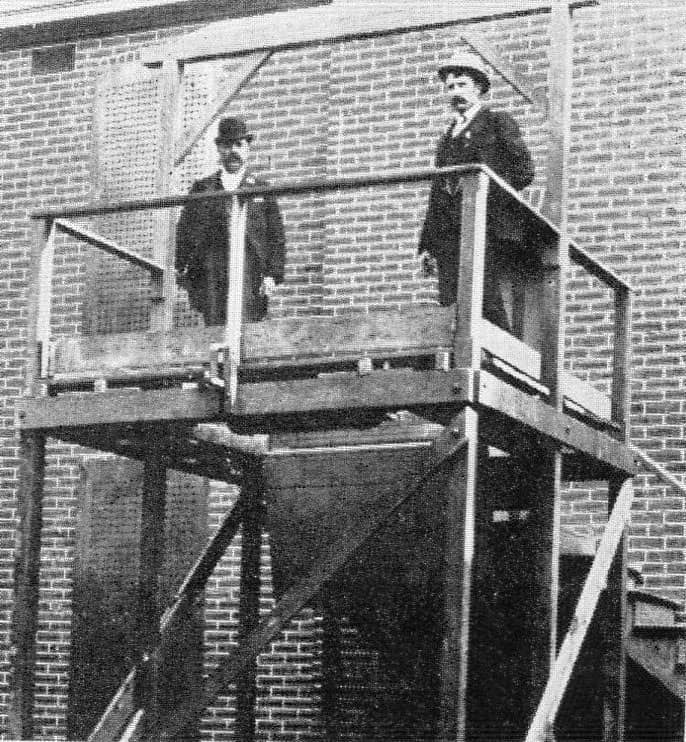
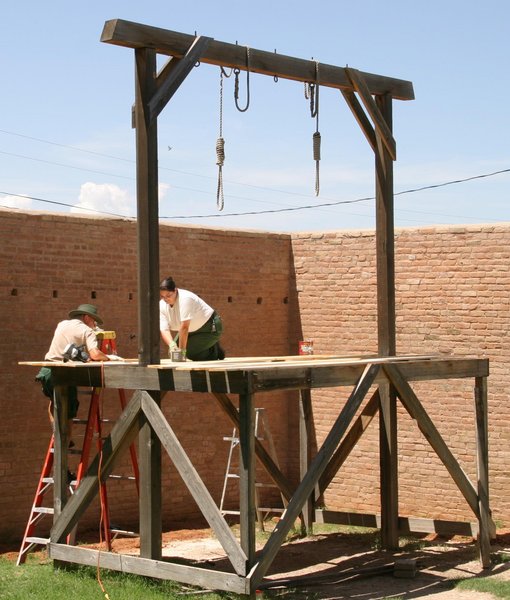
Often, traditional trapdoor-style scaffold gallows were constructed inside a town’s jail yard or town square. They were often made with pine and followed a similar blueprint, according to Buenviaje, with:
…two posts about fifteen feet high, a platform, and a crossbeam some seven feet from the platform. A rope secured the hinged trapdoor mechanism directly beneath the hangman’s noose. Cutting the rope allowed the floor to give way, dropping the victim.
Once constructed, the gallows were watched closely to ensure they weren’t tampered with.
Last Rites
Inside the jail, a condemned prisoner had the opportunity to meet with friends and family, enjoy a final meal, and receive their last rites. Before being hanged, infamous outlaw Rufus Buck wrote a poem on the back of a photograph that was later found in his Fort Smith jail cell.
Prisoners were afforded additional privacy when possible: sheriffs could put up canvas cloth to block windows from onlookers, or move an inmate to a more secluded cell.
When it was time to hang, the somber procession from the jail to the gallows began with a sheriff and a hangman, if he was present, followed by the prisoner, sometimes locked arm-in-arm with a preacher, and often well-dressed in a new suit while sporting a fresh haircut and shave.
Deputies took up the rear guard and ensured the audience stayed safely away from the scaffold.
Tradition holds that 13 steps led to the gallows, though scaffolds may have had more or fewer stairs depending on their size, type and construction.
After ascending the platform, the sheriff would inspect the gallows’ components, and read a death warrant outlining the prisoner’s crimes. Final prayers would follow, and the sheriff would ask the condemned if they had any last words.
Often, the prisoners said little, though sometimes they confessed to their crimes to seek forgiveness in the afterlife. Others would outline their final wishes—where their body should be buried or who could take their postmortem photos—and still others would wax prophetic about their life’s trajectory.
Outlaw Augustine Chacon, when asked his final words in 1902, launched a thirty-minute speech in Spanish proclaiming his innocence in some crimes and confessing guilt to others. Sheriffs and audiences were okay with long speeches at the gallows, as it brought a dramatic element that could be discussed in town for months to follow.
The prisoner may have shaken hands with the sheriff and deputies before a black shroud was placed over his head. His hands were tied, and often, a band was placed around the chest or torso to further restrict arm movements.et were bound to prevent the hanged man (most convicts hanged were men, though some women were also executed) from kicking and flailing.
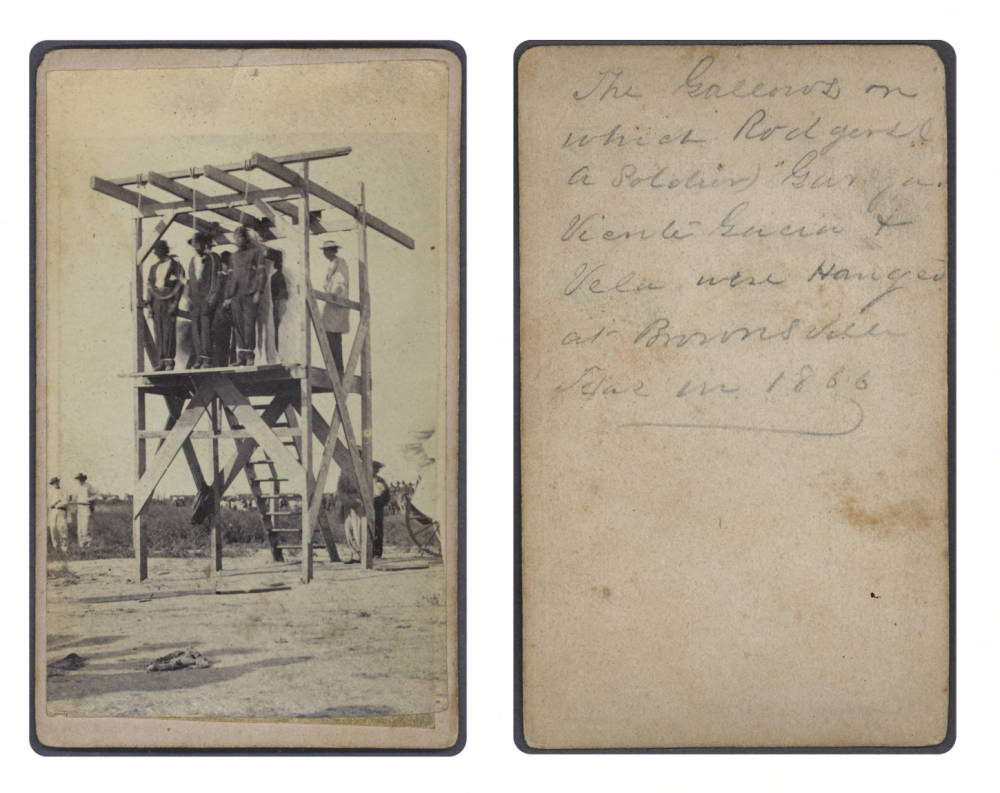
The sheriff or hangman was responsible for the hanging itself. Professional hangmen might make their rounds through nearby counties, but sheriffs were often tasked with personally executing their prisoners.
Communities with fewer funds or resources may have relied on their sheriffs more often, as hiring a hangman could cost around $50 to $100 per execution, depending on the time and location.
But the cost may have been worth it: professional hangmen understood the details of their craft and avoided calamities at the gallows.
The Importance of Hangmen
Hangmen knew that a successful execution occurred when the body was dropped through the trapdoor—or sprung upward in the case of a weighted “twitch-up” gallows—and the prisoner’s neck would break. Ideally, their spinal cord would be severed somewhere between the first and third vertebrae.
An unsuccessful hanging, on the other hand, would leave the prisoner’s neck and spine intact, and they would strangle to death instead of being forced unconscious. Death by strangulation was a gruesome, torturous affair, whereas death by a broken neck and spine involved far less struggle and conscious resistance.
A “clean” hanging depended on many factors, including the hangman’s (or sheriff’s) skill, the rope and knot used as a noose, and the size of the person being hanged.
In one account, a sheriff who didn’t know how to tie a proper hangman’s noose relied on the man being hanged to secure the correct knot. Other stories suggest that a sheriff in one county would ask to borrow the noose of another county’s sheriff if it had successfully hanged criminals in the past.
The hangman’s rope was another critical consideration. The rope had to be of the proper elasticity, length, and width. A rope that was too elastic or too long could make a prisoner drop too far, which could result in a decapitation from the sheer force of the drop. Rope could be made less elastic by soaking it in water and stretching it with weights.
A rope also had to be the correct width—about one inch or so—to avoid cutting into a prisoner’s neck, and it had to be oiled or greased in order to slide well.
Some hangmen preferred a small noose knot, while others—like famous Fort Smith hangman George Maledon, working under Judge Isaac Parker—adopted a large knot that he believed led to a cleaner break of the neck.
The hangman’s knot was typically placed on the left shoulder near the prisoner’s jawline, where it could press against the carotid artery when the body dropped. This would cut off blood supply to the brain quickly and render the hanged person unconscious. It would also make it easier to break the neck in a quick snap of the rope.
Finally, the size and weight of each hanged person had to be considered to avoid a drop that was too short or too long, leading to either strangulation or decapitation.
Whatever their preferences, professional hangmen and their reputations depended on getting the job done right. “One bad job and his career as a hangman was over,” wrote Preece.
The Hanging
After all preparations were made, the trapdoor was finally sprung, and the prisoner would drop “into eternity.”
Even in efficient hangings, a body could sway for ten to fifteen minutes before a physician might no longer find a pulse or heartbeat. One doctor of the time believed a hanged person passed through three stages—a “partial stupor,” unconsciousness, and a “renewed agitation”—that often took longer than onlookers expected.
After death was confirmed, the audience quickly dispersed, as it was considered disrespectful to stick around while the family collected the deceased. The public hanging may have been a social spectacle, but after an execution, a more solemn attitude replaced the day’s earlier buzz.
Temporary scaffold gallows were usually taken down as quickly as they were constructed. In places with federal courts and continual hangings, like Fort Smith in Arkansas, permanent gallows were built to make the execution process more efficient.
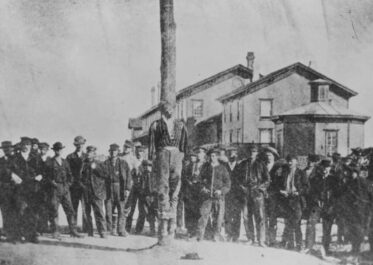
In more remote locales that didn’t have proper jails, jail yards, or courthouses, hangings could also take place on cottonwood trees, high poles, or, in some cases, from the trestles of railroads. In 1894, three men in Russell, Kansas, were hanged from the trestles of a Union Pacific railroad bridge passing over Fossil Creek.
Hangings also took place on the backs of horses and wagons, but in these cases, the short drop of the prisoner after a horse or wagon launched forward was not enough to ensure a proper break of the neck.
When he was hanged by vigilantes in 1864, sheriff-turned-outlaw Henry Plummer allegedly told his executors to “give me a long drop so that I may die quickly.”
Today, public hangings may seem like a grim artifact of the past, but a hanging carried out properly on a traditional gallows was one of the most humane ways to hang someone in the West—especially when compared to the makeshift alternatives.
Making hangings public may seem morally questionable now, but at the time, these displays were believed to deter future criminal activity while satisfying the morbid curiosity of townspeople who often had little in the way of entertainment.
Sources & Further Reading
- Akins, Jerry. Hangin’ Times in Fort Smith: A History of Executions in Judge Parker’s Court.
- Bakken, Gordon Morris. Invitation to an Execution: A History of the Death Penalty in the United States. University of New Mexico Press, 2010.
- Gilbreath, West. Death on the Gallows: The Encyclopedia of Legal Hangings in Texas.
- Gilbreath, West. Death on the Gallows: The Story of Legal Hangings in New Mexico, 1847-1923.
D.T. Christensen is the founding editor of OldWest.org, a history website committed to sharing and preserving stories of the American West. He was born and raised in Phoenix, Arizona, studied journalism at Northern Arizona University, and spent decades exploring the landscapes and history of the American West before moving to Massachusetts.